REVIEW · AMSTERDAM
Amsterdam: Historic City Sightseeing Canal Cruise
Book on Viator →Operated by Amsterdam Circle Line · Bookable on Viator
A canal cruise in Amsterdam that actually fits your schedule. This 1-hour ride gives you a fast, scenic way to see the UNESCO Canal Ring from the water, with commentary in English and a route packed with landmarks.
Two things I really like: the meeting point is easy to find right in front of the Anne Frank House, and the short time makes it ideal when you’re juggling museums, bikes, and dinner plans. One thing to keep in mind is that the narration is delivered via onboard audio and some seats can make it harder to hear, especially in busier or colder conditions.
In This Review
- Quick Highlights To Know Before You Go
- Why This 1-Hour Canal Cruise Is a Smart Amsterdam First Move
- Start at Anne Frank House: How to Get On Without Stress
- Museum of the Canals to Anne Frank Huis: Two Different Kinds of Amsterdam Meaning
- Westerkerk and the Surrounding Canal Belt: Read the City’s “Official” Side
- Houseboat Museum Moment: The City’s Daily Life, Not Just the Postcards
- The Mid-Route Canals: Leidsegracht, De Beulingsloot, and Bridge Details
- Melkmeisjesbrug: A Bridge With Map-Signed History
- Brouwersgracht and the “Named Borders” Effect
- Churches, Stations, and the City’s Big-City Identity From the IJ
- EYE Filmmuseum and Posthoornkerk: Modern Culture Meets a Historic Canal Edge
- The Amstel Finale: Hermitage, Stopera, and Why the Ending Feels Big
- Boat Comfort, Seating, and Audio: The Stuff That Makes or Breaks the Experience
- Value Check: Is $18.71 Worth One Hour on the Water?
- When This Cruise Is the Right Choice (and When It’s Not)
- Should You Book This Amsterdam Circle Line Canal Cruise?
- FAQ
- How long is the Amsterdam canal cruise?
- Where do I meet the tour?
- Is the cruise commentary available in English?
- Do I need a printed ticket?
- How far in advance should I book?
- How many people can be on the boat?
- Is it suitable for most travelers?
- Are service animals allowed?
- Can I get a full refund if my plans change?
Quick Highlights To Know Before You Go
- Easy to start at Anne Frank House: simple location near major streets and sights
- UNESCO Canal Ring from the water: churches, bridges, and historic façades in one sweep
- Real “time saver”: about an hour for big-picture Amsterdam
- English onboard guidance: designed for visitors who want story, not just scenery
- Small enough to stay pleasant: capped at 68 travelers
Why This 1-Hour Canal Cruise Is a Smart Amsterdam First Move
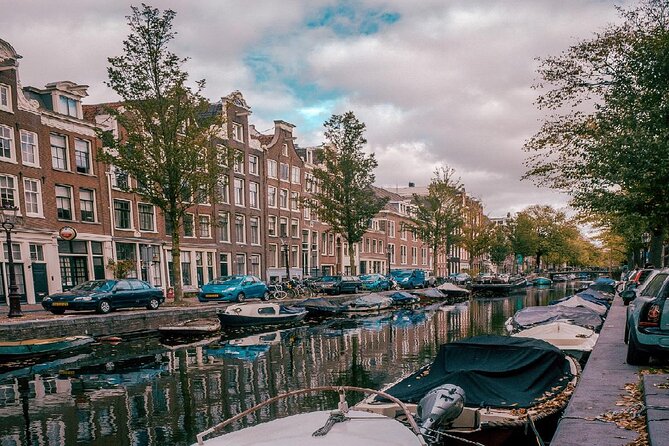
Amsterdam can eat your day. One minute you’re walking for coffee, the next you’ve wandered into a courtyard you didn’t plan on. A short canal cruise is one of the few activities that quickly fixes that problem—you get orientation plus iconic sights without committing to an entire afternoon.
This cruise is priced at $18.71 per person, which is low for a full hour on the water in a top-tier city. The value isn’t just the boat time. It’s that you’re seeing a stack of famous canal-belt buildings and waterfront structures back-to-back, including churches, historic houses, bridges, and the city’s big modern showpieces.
Also, it’s built for people who don’t want to “tour” like it’s a class. The experience is short, with guidance in English, and you can take in the view through windows and overhead glass while the boat moves past the sights.
You can also read our reviews of more boat tours in Amsterdam

Start at Anne Frank House: How to Get On Without Stress
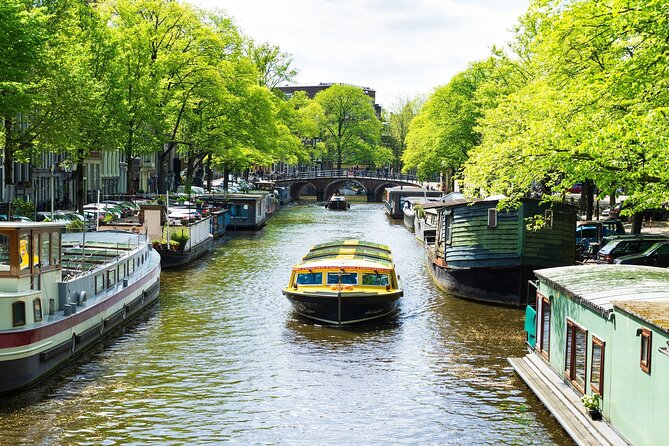
The best part of this experience is how straightforward it is to begin. Your meeting point is in front of the Anne Frank House, and that matters more than it sounds. When a tour starts in a confusing spot, you lose energy before you even board. Here, you’re dropped into a recognizable landmark area and you can connect the cruise with your day.
If you’re combining it with other visits, the location is very handy. You can do the Anne Frank House one day and still return to the same neighborhood later, or do the cruise first to get a better sense of the canal geography around central Amsterdam.
Practical tip: arrive a bit early and do a quick check of the correct boarding area. The cruise is capped at 68 travelers, but it’s still a popular central pickup spot.
Museum of the Canals to Anne Frank Huis: Two Different Kinds of Amsterdam Meaning
Right away, the route sets you up to read the city like a puzzle. The first stop is the Museum of the Canals, where the theme is “this is how Amsterdam’s waterways shaped the city.” That context is useful because the canals aren’t just pretty—they’re how Amsterdam grew and how neighborhoods formed.
Then you pass the Anne Frank House (Anne Frank Huis) on the Prinsengracht, near the Westerkerk. Even if you already know the story, the setting hits differently from the water. You’re looking at a canal house in its real place—on a canal that’s been part of daily life for centuries.
What’s especially powerful here is the continuity: the building dates to the 17th century, and the story of the Secret Annex is tied to that exact structure. The diary was published in 1947, and a decade later the Anne Frank Foundation formed to protect the property from development plans. Seeing the house externally from the boat doesn’t replace the museum experience—but it helps you place the site in the wider canal-belt environment.
Westerkerk and the Surrounding Canal Belt: Read the City’s “Official” Side
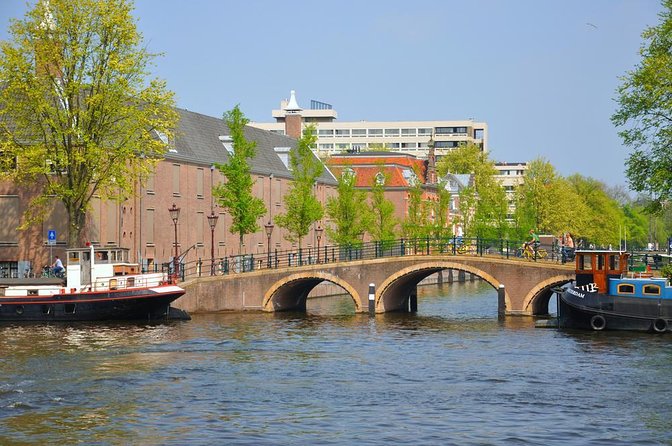
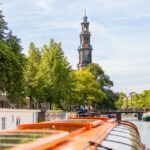
After that, the cruise brings you past the Westerkerk, a Reformed church in Dutch Protestant Calvinism in central Amsterdam. Its position matters: it sits between major canals in the Grachtengordel neighborhood, near the Jordaan, with the Prinsengracht and Keizersgracht forming key boundaries.
From the water, churches can feel like landmarks you can’t miss—even if you’ve never studied Amsterdam architecture. You start to recognize the city’s “serious buildings” versus the canal houses and merchant structures. And because the cruise keeps moving, you don’t have to choose between walking up close to one sight or missing the rest.
A small consideration: if you want the guide’s commentary to stay clear, pick your spot with sound in mind. Some seating choices are better for views than for hearing onboard audio.
Houseboat Museum Moment: The City’s Daily Life, Not Just the Postcards
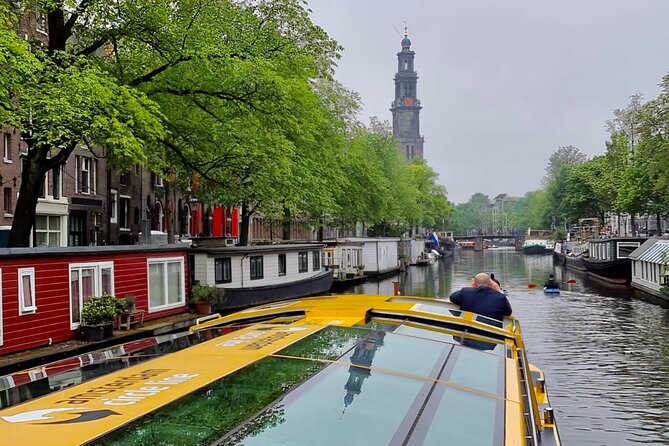
One of the more memorable segments is the Houseboat Museum. This is where Amsterdam stops feeling like a museum city and starts feeling like a living one.
The museum is in a former cargo ship called Hendrika Maria built in 1914. The cargo hold is now a cozy living space, and the idea is to show you what houseboat life can be like—space, comfort, and daily practicality. It’s a nice contrast to the historic façades of the canal belt because it reminds you that people still live on these waterways, not just pose for photos beside them.
If you’re the kind of traveler who likes a city’s “real-life” details (how people actually live), you’ll appreciate this stop.
You can also read our reviews of more city tours in Amsterdam

The Mid-Route Canals: Leidsegracht, De Beulingsloot, and Bridge Details
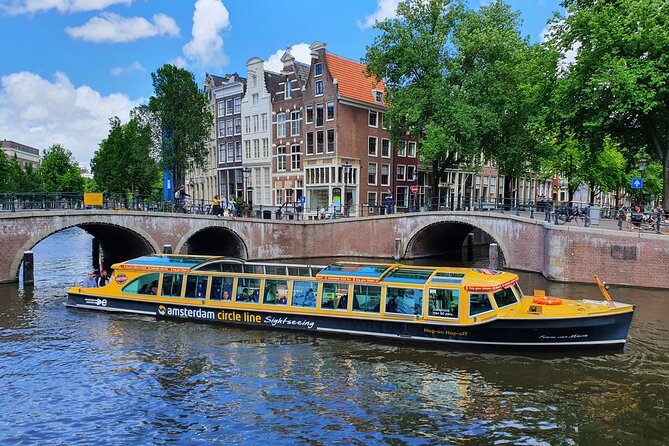
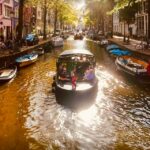
As the boat continues, the cruise threads through smaller canal stretches that make Amsterdam feel close and human. Leidsegracht is a cross-canal in Amsterdam-Center connecting several major canals, linking Herengracht, Keizersgracht, Prinsengracht, and Lijnbaansgracht. It’s the kind of canal network you’ll never fully understand just by walking a single street.
Then comes De Beulingsloot, one of the oldest and shortest canals in the center. Because it’s short, it often reads like an “in-between” waterway—small enough to feel tucked into the city fabric.
You’ll also pass the Bartolotti House, a canal house at Herengracht 170-172 built around 1617. The backstory here is money and trade: it was built for a wealthy Amsterdams resident, with inheritance connected to a merchant from Bologna. This is the kind of detail that makes the canal belt feel more than scenic. You start seeing who built these spaces and why they mattered.
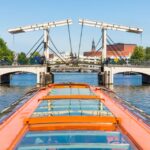
Melkmeisjesbrug: A Bridge With Map-Signed History
One of the more fun details is the Melkmeisjesbrug. The bridge has existed for centuries and appears on maps signed by several cartographers over time. Its modern form starts in 1883 when a pedestrian drawbridge was replaced by a permanent bridge—made possible because shipping had largely ended.
Even then, the passage was narrow, so later renovations adjusted the structure. The bridge also ties to the old milk market and a milkmaid sign image, giving it a little everyday-economy story instead of only a construction story.
From the water, bridges like this are more than obstacles. They’re time markers.
Brouwersgracht and the “Named Borders” Effect
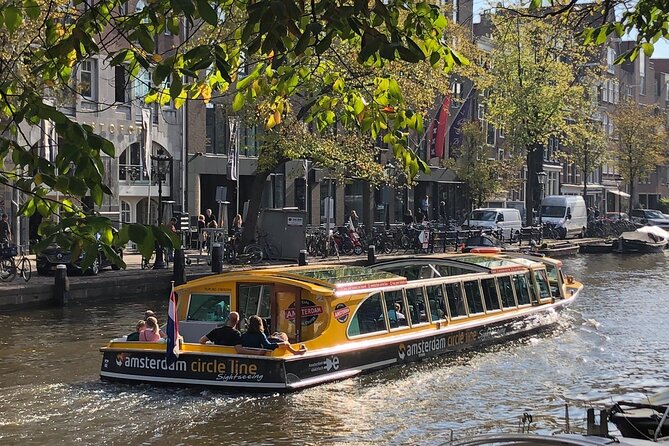
The cruise includes Brouwersgracht, which connects the Singel with the Singelgracht and helps mark the northwestern border of the Grachtengordel. It also outlines the northern edge of the Jordaan neighborhood between the Prinsengracht and the Singelgracht.
This is useful because it teaches you Amsterdam’s mental map: neighborhoods and canal belt lines aren’t abstract. They’re physical. Once you recognize that, you can walk the city better afterward.
You’ll also pass details like house-numbering logic that starts at Brouwersgracht—again, not something you’d guess from street level, but easy to remember if you learn it while floating by.
Churches, Stations, and the City’s Big-City Identity From the IJ
The route doesn’t stop at canal-belt nostalgia. It also shifts toward Amsterdam’s larger civic and waterfront identity.
You pass a church designed by Adriaan Dortsman, opened in 1671, with major rebuilding later and an organ built by J Batz in 1830 and restored in 1983. The building’s purpose evolved: in 1935 the Lutheran community left and it became a concert hall. Later, in 1975, a tunnel was built by the adjacent Sonesta Hotel (now the Renaissance Amsterdam Hotel) for access, and the church saw another restoration after a dome fire in 1993.
That sequence is a reminder: Amsterdam’s landmark buildings keep changing roles. The city reuses structures instead of starting over.
Then you’ll see Amsterdam Centraal, designed by Pierre Cuypers, who also designed the Rijksmuseum. Even if you’re not a building nerd, Cuypers’s style is part of Amsterdam’s visual language. And the station’s grandeur looks extra sharp from the water, where scale feels different.
After that, the cruise goes to the IJ, a former bay that’s now Amsterdam’s waterfront. This is where the city feels more open and modern.
EYE Filmmuseum and Posthoornkerk: Modern Culture Meets a Historic Canal Edge
A standout modern stop is EYE Filmmuseum, designed by Delugan Meissl Associated Architects. The building includes multiple gallery spaces and several cinema rooms, including a 300-seat cinema and smaller ones.
From the canal, modern architecture gets a clean stage. The building’s mass and angles contrast nicely with the older brick and canal-side forms you’ve been seeing. It makes Amsterdam feel less “frozen in time” and more like it keeps building.
Not far from that, you’ll pass the Posthoornkerk, designed by P.J.H. Cuypers and completed in phases (1860–1863 for the main body, 1887–1889 for the two-tower front). It replaced the earlier hidden church De Posthoorn on the Prinsengracht. The church needed to be built in constrained space, so it was made extra high and included galleries above the side aisles. The exterior reads neo-Gothic, while the interior references the late Romanesque Munsterkerk in Roermond.
This mix of old and new is why this cruise works: it’s not just a single “period” stroll.
The Amstel Finale: Hermitage, Stopera, and Why the Ending Feels Big
The cruise continues along the Amstel, a river that flows from areas south of Amsterdam and heads to the IJ. It’s tied to events like Liberation Day concerts, rowing races, and a Pride boat parade.
Then you reach Hermitage Amsterdam, a branch of the Hermitage Museum in Saint Petersburg. It’s located on the banks of the Amstel in the former Amstelhof building dating to 1681. The cruise doesn’t turn into a full museum visit here, but you get a strong impression of how museums sit right against everyday water.
Finally, you pass Stopera, the complex that houses the city hall and the Dutch National Opera and Ballet. Its name comes from protest slogans—Stop the Opera—because people opposed building the complex. It’s a reminder that even civic megastructures have human stories behind them.
Ending here makes sense. You start in the emotionally charged Anne Frank neighborhood and end in Amsterdam’s institutional and cultural center. That arc gives the hour more meaning than a simple sightseeing loop.
Boat Comfort, Seating, and Audio: The Stuff That Makes or Breaks the Experience
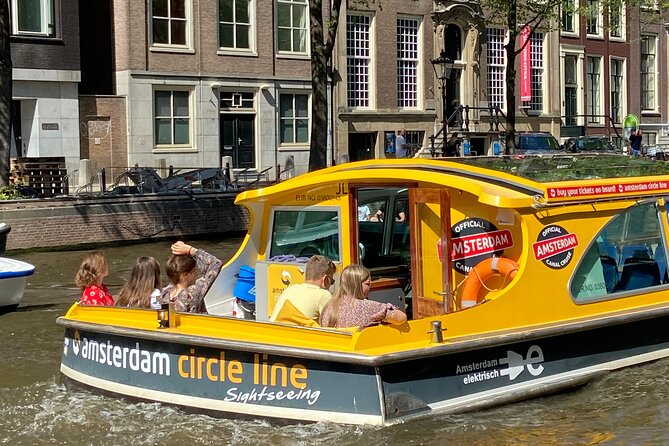
This is an enjoyable cruise even when the weather isn’t perfect. The boat is set up so you can choose where you sit: inside or outside. That flexibility is handy because Amsterdam wind can change your mood fast.
I’d plan your seating based on what you care about most:
- If you want the best view, you may prefer seats with the most open sightlines (some seats near the back are reported to be great for visuals).
- If you want the narration to stay clear, don’t assume every seat hears equally. There are reports of audio being harder to hear in certain places and that the language switching can feel choppy.
A small but real comfort point: on colder days, you’ll probably want to dress for wind and bring a layer. One suggestion that came up was offering hot drinks onboard for cold times, which tells you the weather factor matters.
Value Check: Is $18.71 Worth One Hour on the Water?
For many visitors, yes—especially if you use the cruise as a planning tool.
Here’s why the price works: you’re paying for an hour of prime waterfront access plus a guided script in English that points out landmarks in sequence. That beats the alternative of trying to “figure it out” by walking, taking trams, and trying to connect the dots yourself.
Also, the group limit of 68 keeps it from turning into chaos. You’re still on a boat with other people, but it’s not a huge floating crowd.
If you already know you’ll spend most of your time on museums and don’t want to spend energy on logistics, this cruise is an easy win.
When This Cruise Is the Right Choice (and When It’s Not)
This fits best if you:
- have only a short time in Amsterdam and want big-picture orientation
- want to see canal-belt highlights without a long walk
- like a mix of historic landmarks and modern city structures
- prefer a calm ride with guidance rather than a sprinting city tour
It may feel less ideal if:
- you strongly want live, on-the-spot explanations for each building (audio-based narration may feel limiting)
- you need very clear sound and are sensitive to low volume or background noise
- your timing falls on a major canal event, where departures can be disrupted
Should You Book This Amsterdam Circle Line Canal Cruise?
If your goal is to see Amsterdam’s most famous sights quickly from the water, I think this is a solid booking. The Anne Frank House meeting point alone makes it easier than many canal tours, and the route covers both “classic canal belt” and “Amsterdam today” landmarks like EYE Filmmuseum and the Stopera complex.
Book it if you want an hour that helps you navigate the rest of your trip. Skip it or choose a different format if you’re chasing live guide storytelling for every single building and you hate when audio is hard to hear.
If you do go, pick a seat based on whether you care more about views or narration, and dress for Amsterdam wind.
FAQ
How long is the Amsterdam canal cruise?
It runs for about 1 hour.
Where do I meet the tour?
The meeting point is in front of the Anne Frank House.
Is the cruise commentary available in English?
Yes, it’s offered in English.
Do I need a printed ticket?
No. It uses a mobile ticket.
How far in advance should I book?
On average, this experience is booked about 14 days in advance.
How many people can be on the boat?
The tour has a maximum of 68 travelers.
Is it suitable for most travelers?
Yes, most travelers can participate.
Are service animals allowed?
Yes, service animals are allowed.
Can I get a full refund if my plans change?
Yes. You can cancel up to 24 hours in advance for a full refund.