REVIEW · AMSTERDAM
Dutch Cheese & Drinks Guided Amsterdam Boat Tour, All Inclusive
Book on Viator →Operated by Sloepon Amsterdam Canal Tours · Bookable on Viator
Cheese and canals in 60 minutes. This one-hour electric boat ride takes you through some of Amsterdam’s oldest waterways while you enjoy real Dutch Gouda and unlimited beer and wine. My only real heads-up is simple: there is no toilet on board, so plan for that before you board.
I like that the live guide keeps the sights moving fast, with plenty of real context as you pass major landmarks from the water. You’ll also get flexibility with multiple start times, which helps if you want your boat trip early, late, or between other plans. If you like classic photo moments, this route is built for them, including the lineup for the Zeven Bruggen view.
In This Review
- Key things that make this tour fun and practical
- Price and what you actually get for $21.77
- Setting off from Oudezijds Voorburgwal and the narrow 14th-century canals
- Monks, merchants, and the Oude Kerk’s story in the Red Light District
- From Pierre Cuypers to Amsterdam’s view debates: the Neo-Renaissance station
- The green rooftop of Renzo Piano and the old shipyard docks
- VOC power on the water: replica ship and Admiralty warehouse clues
- Amstel opens up: Golden Bend mansions and the Dutch Golden Age
- Reguliersgracht and Zeven Bruggen: the photo lineup moment
- Munttoren and coin-minting during French silver blockades
- Magere Brug and the skinny-bridge legend for couples
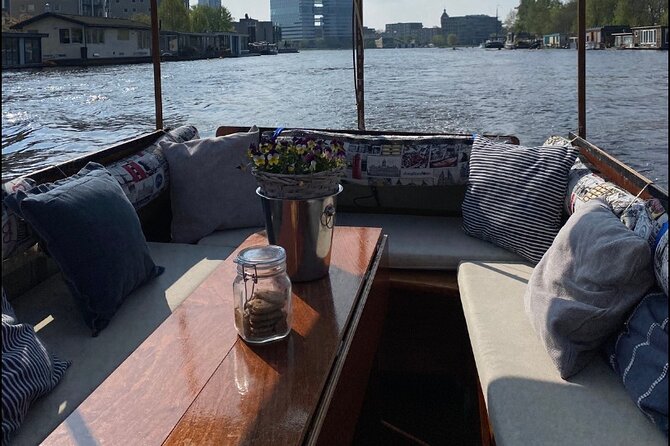
- Cheese, wine, and soft drinks on a 100% electric boat
- The guide rhythm: stories that connect dates to buildings
- Logistics that can make or break your experience
- Should you book this Dutch cheese and drinks Amsterdam boat tour?
- FAQ
- How long is the Dutch Cheese & Drinks Guided Amsterdam Boat Tour?
- What is the price per person?
- What is included in the tour?
- Is a mobile ticket used?
- What is not included?
- Is the tour offered in English?
- Where do I meet for the tour?
- Are service animals allowed?
- What happens if the weather is bad?
- Can I cancel for a full refund?
Key things that make this tour fun and practical
- Electric boat ride for a smooth, modern canal experience
- Unlimited beer, wine, and soft drinks paired with Gouda cheese
- Medieval canal start in narrow lanes only small boats can reach
- Top photo windows like Zeven Bruggen and Magere Brug
- Live guide + skipper with stories that connect buildings to trade and power
Price and what you actually get for $21.77
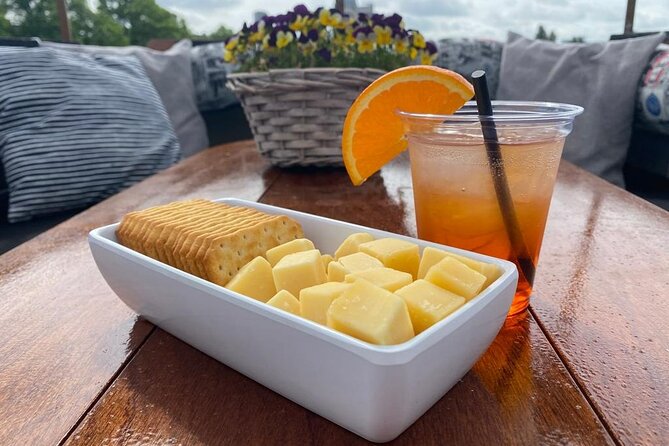
At $21.77 per person for about an hour, this tour is priced like a solid value slot in an Amsterdam day. The best part is that it is truly all inclusive for the main extras: you get unlimited beer, wine, and soft drinks, plus a generous platter of Dutch Gouda cheese. That turns the usual canal-boat problem on its head, where you pay for scenery and then pay extra for drinks.
You’re also buying time. With a guided route, you can see a lot of Amsterdam landmarks without figuring out where the water-view angles are. You’ll get a live English guide and skipper, and the boat is 100% electric, which matters if you prefer a quieter ride and less fuss compared to older motorboats.
The trade-off is that this is still one hour. If you want long stops to get photos on land, you’ll likely feel a bit rushed, even though the views from the boat are generally the point.
You can also read our reviews of more boat tours in Amsterdam

Setting off from Oudezijds Voorburgwal and the narrow 14th-century canals
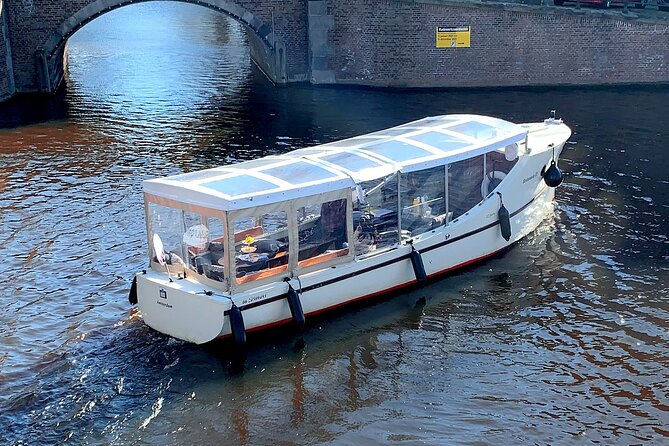
You start at Oudezijds Voorburgwal 226, in a part of Amsterdam that feels tucked away. The route begins in narrow canals dating back to the 14th century, where the waterways are so tight that only small boats can pass. From the first minutes, you can feel the difference between a broad tourist canal and a quieter medieval pocket.
This is one of the reasons I enjoy this style of cruise. You don’t start the clock by looking at the most obvious skyline views. Instead, you ease into Amsterdam as a working city built around water access, tiny lanes, and bridges that connect neighborhoods without turning the whole system into one big parade.
Tip: give yourself extra time to find the dock at the start point. One firsthand traveler experience mentioned how hard it was to locate the exact docking spot using maps and street directions. If you’re arriving by tram or walking in from a nearby hotel, arrive early, not right on time.
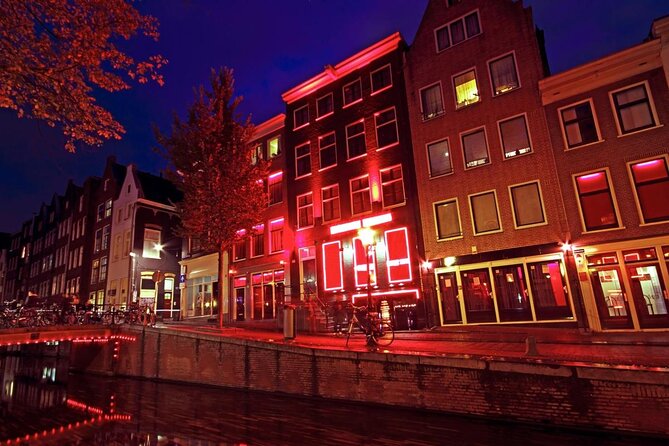
Monks, merchants, and the Oude Kerk’s story in the Red Light District
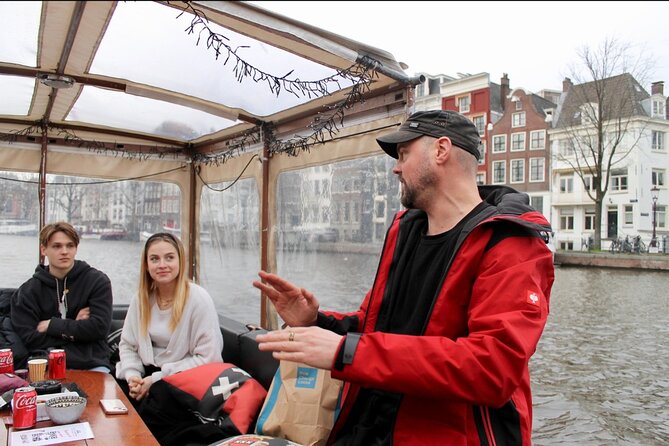
As you glide onward, the boat drifts through quieter canals once used by monks and merchants. The buildings and bridges you pass here help explain why Amsterdam looks the way it does today: trade routes, religious communities, and daily commerce all depended on water access.
Then comes one of the route highlights: Oude Kerk, built in 1306. From the water, you hear about its transformation from a Catholic church into a Calvinist landmark, which is already a big enough story. The extra twist is that it sits in the middle of today’s Red Light District area, so you get a lesson in how religious and social life shifted over centuries.
This stop works well even if you only know a little about Dutch Protestant history. The guide’s job is to connect the dates to what you see around you, so the church doesn’t feel like a random old building. It feels like a pivot point in the neighborhood’s long timeline.
From Pierre Cuypers to Amsterdam’s view debates: the Neo-Renaissance station
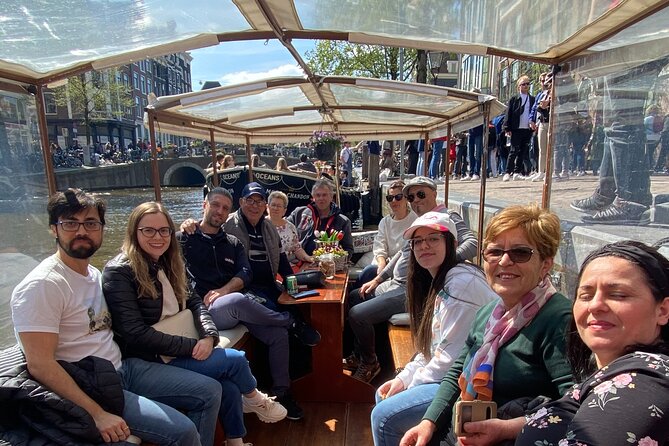
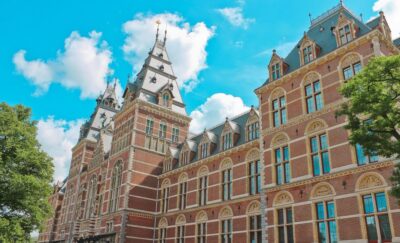
Next, you sail past the grand Neo-Renaissance station from the water. The building is designed by Pierre Cuypers, the same architect behind the Rijksmuseum. That connection helps you understand why Amsterdam’s big landmarks often share a visual language, even when they serve totally different purposes.
You also hear a fascinating bit of civic drama: the station once caused outrage for blocking the city’s view of the IJ. That’s a great reminder that even in the 19th century, people argued about what buildings should be allowed to do to city sightlines.
I like this part because it turns a photo stop into a “why did they build it like that” conversation. If you enjoy architecture and city planning debates, you’ll get a lot from the commentary as the boat passes.
The green rooftop of Renzo Piano and the old shipyard docks
Sailing under a striking green rooftop designed by architect Renzo Piano is one of those moments where you immediately notice you are moving through different eras of Amsterdam. The building rises from what used to be shipyard docks, tying the modern structure to the city’s industrial harbor past.
This section is valuable because it explains a pattern: Amsterdam kept transforming its waterfront. It shifted from ships and labor to institutions and offices, but it never stopped being a city built on movement along the water.
If you’re the type who likes to “read” a city as you travel, this stop is a good one. You’ll understand why the architecture feels bold, and why the canals are still part of how the city functions.
You can also read our reviews of more guided tours in Amsterdam

VOC power on the water: replica ship and Admiralty warehouse clues
You pass a replica of an 18th-century VOC ship called Amsterdam, which symbolizes Dutch maritime power. The VOC reference helps you place the country’s trading era into a tangible object you can see as you move along the canal.
Right alongside that, you hear that the museum itself was once the naval warehouse of the Admiralty, storing items like gunpowder, sails, and rope. That’s a key detail because it connects the building’s modern role to what the area was meant for: storing what ships needed to launch and keep going.
Even if you don’t plan to go inside a museum that day, the story gives you a mental map. You start to see the canal area as a supply chain, not just an attractive waterfront.
Amstel opens up: Golden Bend mansions and the Dutch Golden Age
When you reach the Amstel, the canals open out, and the water feels bigger under you. The Amstel also once marked the edge of the medieval city, and the route explains how essential it was for trade and transport. This is one of those “now I get it” moments for first-time Amsterdam visitors.
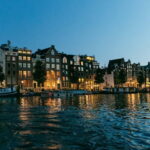
Then you sail past the Golden Bend, known as the spot where Amsterdam’s richest merchants built grand canal mansions during the 17th-century Dutch Golden Age. From the water, you get a different sense of scale than from a street-level walk. The deep plots and ornate facades look like the physical language of wealth and power.
I find that this part of the cruise works for nearly everyone, even if you’re not an architecture person. You’ll understand that these weren’t just pretty houses. They were status markers built for an economy driven by shipping, trade, and money moving through the canals.
Reguliersgracht and Zeven Bruggen: the photo lineup moment
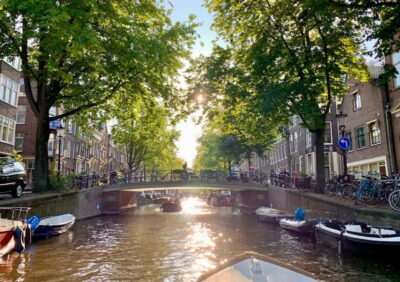
One of the best photo stops on the route is Zeven Bruggen, the Seven Bridges. As you cruise through Reguliersgracht, you can see all seven historic bridges lined up for one of those classic Amsterdam shots.
I like this because it’s built for the camera without requiring you to sprint around the city. You get a relatively clean line of sight from the boat, so you can shoot without worrying about where to stand on land.
Practical tip: have your camera or phone ready before the boat turns into the view. If you wait until the moment hits, you’ll spend your best angle fiddling.
Munttoren and coin-minting during French silver blockades
Near the flower market area, you’ll spot the Munttoren, which was once part of the city wall system. In the 17th century, it served a very specific national purpose: minting coins when the French blocked silver deliveries to the Dutch Republic.
That kind of detail is why a guided route beats a self-guided wander. You can see a tower from the canal and think it’s just another old structure. With the coin-minting context, it becomes an economic survival tool.
If you’ve ever wondered how money, politics, and trade show up in a city’s buildings, this stop gives you a direct answer.
Magere Brug and the skinny-bridge legend for couples
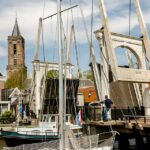
Toward the end of the cruise, you’ll pass Magere Brug, a white wooden drawbridge often described as one of Amsterdam’s most romantic spots. The route shares a local legend that couples who kiss while passing under the bridge will stay together forever, which is classic Dutch storytelling.
The nickname Skinny Bridge also comes from reality. The bridge was so narrow that two pedestrians could barely pass each other. That small structural detail adds a lot to the vibe, because you can picture how the space shaped daily interactions.
Even if romance legends aren’t your thing, this is still a strong visual moment. You’ll get a close, direct view of a landmark that people actively seek out on foot, but here you see it from the canal at a comfortable pace.
Cheese, wine, and soft drinks on a 100% electric boat
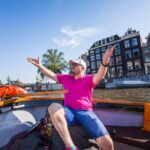
This tour’s “all inclusive” promise is straightforward: you get unlimited beer, wine, and soft drinks, plus Dutch Gouda cheese. In practice, it means you can focus on the ride instead of making decisions every few minutes.
One practical advantage of eating and drinking onboard is timing. The cruise route covers a lot in a short span, so having the cheese and drinks at hand keeps the experience moving. You don’t have to leave the boat for snacks or plan a separate stop.
A small drawback is also obvious from the included details: there is no toilet on board. That matters more than you might think if you’re traveling with kids, drinking a lot of included beverages, or you’re simply sensitive to timing. If you know you’ll want a break, do it before boarding.
Also, because the boat is electric, the ride can feel calmer than you expect for a city crisscrossing day. It doesn’t remove the fact that it’s still a canal environment, but it tends to make the experience feel smoother.
The guide rhythm: stories that connect dates to buildings
The biggest reason people rank this cruise so highly is how the commentary lands. Guides and skippers share stories with humor and quick clarity, so major landmarks stop feeling like names on a map.
You might hear guides like Andre and David, Louise, or Josh, and you may even learn from captains such as Huib. On some departures, hosts like Teich, Ties, Kat, Tallan, or Tamar may be running the show. The consistency you’re looking for is the same: lively explanations, city trivia that connects to what you see, and a sense of humor that keeps the hour from dragging.
The stop-by-stop structure also helps. Each new sight adds another layer, from medieval canal corners to 1300s church transformation, then to 1600s merchant wealth, and finally to 1700s maritime power.
One more practical point: because the cruise is around an hour, the pacing is tight. If you want extra time for one specific bridge or building, pick your favorite early. The boat’s route is fixed, and time will move on.
Logistics that can make or break your experience
This is the kind of tour where small practical details matter.
- Meeting point: Oudezijds Voorburgwal 226, and you’ll return to the same spot at the end.
- Start times: you can choose from multiple departures, so you can fit it to your day plan.
- Ticket: you get a mobile ticket, which is handy if you’re juggling transit and quick walks.
- Weather: the experience requires good weather. If it’s canceled due to poor conditions, you’ll be offered a different date or a full refund.
And because the maximum size for the activity is up to 180 travelers, you should expect a busy board-and-depart flow. That makes arriving early even more useful. If you’re carrying a coat or want time to locate the dock, do it before you’re stressed.
Should you book this Dutch cheese and drinks Amsterdam boat tour?
I think it’s a strong yes if you want a quick, high-value canal experience with real Amsterdam context. For about an hour, you get the water views, the included beer, wine, and Gouda, and a live guide who ties landmarks to stories you won’t get from a casual walk.
Book it if:
- You’re short on time and want several major sights in one go
- You like guided history that stays practical and easy to follow
- You’re happy to keep it moving since this is an hour-length cruise
Skip it or think twice if:
- You strongly need toilet access during the trip (there isn’t one onboard)
- You’re sensitive to weather and don’t want to plan around a good-weather requirement
- You want long stops on land, since the value here is the boat-side viewing and commentary
If you match those points, this is the kind of Amsterdam tour that feels like a day-plan saver. You’ll leave with photo moments like Zeven Bruggen and Magere Brug, and with a clearer picture of how trade, power, and architecture shaped the canals you just sailed.
FAQ
How long is the Dutch Cheese & Drinks Guided Amsterdam Boat Tour?
It lasts about 1 hour.
What is the price per person?
The price is $21.77 per person.
What is included in the tour?
You get unlimited beer, wine, and soft drinks, plus a generous platter of Dutch Gouda cheese. The tour also includes a skipper and a live guide, and it runs on a 100% electric boat.
Is a mobile ticket used?
Yes, the tour uses a mobile ticket.
What is not included?
There is no toilet on board, and the tour is not wheelchair accessible.
Is the tour offered in English?
Yes, it is offered in English.
Where do I meet for the tour?
The meeting point is Oudezijds Voorburgwal 226, 1012 GJ Amsterdam, Netherlands, and the tour ends back at the meeting point.
Are service animals allowed?
Yes, service animals are allowed.
What happens if the weather is bad?
The experience requires good weather. If it is canceled due to poor weather, you’ll be offered a different date or a full refund.
Can I cancel for a full refund?
Yes. You can cancel up to 24 hours in advance for a full refund. If you cancel less than 24 hours before the start time, it is not refundable.