REVIEW · AMSTERDAM
Amsterdam in World War Two Cycle Tour
Book on Viator →Operated by Slagveldreizen.nl · Bookable on Viator
Amsterdam history hits different when you’re pedaling. This Amsterdam South cycle tour links real streets to specific WWII events, with wartime photos that match what you see today. I love how it pairs local details with a clear story, and I especially like the small group feel—max six—so your questions don’t get swallowed.
The tour also gives you a practical way to cover ground without walking for hours, and you even get access to areas cars can’t reach easily. One drawback to consider: this route spends time on arrests, deportations, and resistance reprisals, so it’s not a light, fluffy sightseeing loop.
In This Review
- Key points at a glance
- Cycling Amsterdam South’s WWII sites without tour-bus crowds
- Your ride plan: start point, small group size, and timing
- From Daniël Willinkplein to Olympiaplein: the 1943 Judenaktion stops
- Anne Frank’s neighborhood trail at Merwedeplein and Waalstraat
- Tilex Bar, PBA barracks, and Museumplein’s Nazi offices and bunkers
- Resistance photography at Roelof Hartstraat and memorials in plain sight
- Executions and retaliation along Beethovenstraat and Euterpestraat
- SD HQ, stolen-property offices, and RAF’s role near Rubensstraat
- Olympiaplein registration, Luftwaffe HQ, and Queen Emma’s defiance
- The final ride through Vondelpark and the meaning of May 7, 1945
- Value: what $66.09 buys you in context and conversation
- Should you book this tour or choose something else?
- FAQ
- Where does the Amsterdam in World War Two Cycle Tour start?
- How long is the bike tour?
- What group size is this tour?
- What language is the tour offered in?
- Is a mobile ticket used for this tour?
- How much does the tour cost?
- What kinds of WWII sites will you see?
- Will there be a break during the ride?
- What is the cancellation policy?
Key points at a glance
- Bike through Amsterdam South to reach places outside the usual center crowd
- WWII before-and-after photos make today’s streets feel eerily familiar
- Max six people keeps the pace calm and questions easy
- Rudy and Peter guide with local ties and lots of story detail
- Focused route follows key locations connected to the 1940–1945 occupation
Cycling Amsterdam South’s WWII sites without tour-bus crowds
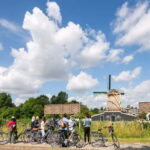
I like history tours that respect your time and your legs. This one trades the hop-on, hop-off chaos for steady bike time, letting you move between sites that would take forever on foot. The focus stays tight on Amsterdam’s south neighborhoods—often quieter than the center—so you can actually hear what your guide is saying.
You’ll also notice a different kind of “Amsterdam angle.” The Netherlands is flat, but this tour uses that advantage to do something smart: stitch together a timeline across multiple districts. That matters because WWII in Amsterdam wasn’t one dramatic moment—it was layers of systems, offices, raids, hiding, and retaliation.
The tour’s biggest hook is the way historic photos are used at the stops. Instead of hearing about the past in the abstract, you compare what stood there then with what stands there now. It’s a simple tool, but it turns the route from lecture to street-level understanding.
You can also read our reviews of more cycling tours in Amsterdam
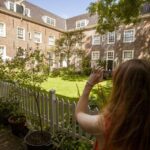
Your ride plan: start point, small group size, and timing
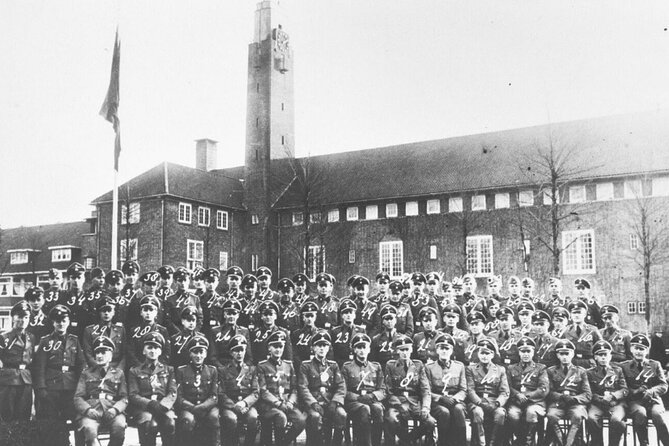
You meet at Tesselschadestraat 1, 1054 ET Amsterdam, and the tour starts at 11:00 am. Expect about 2 hours 30 minutes to 3 hours 10 minutes, and the tour ends back at the meeting point.
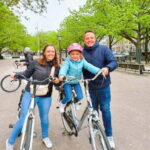
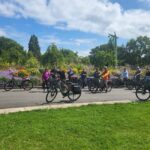
The operator keeps the group small: up to six travelers. In plain terms, that gives you time at each stop and enough space to keep moving without rushing everyone through. Reviews repeatedly highlight that the cycling feels safe—a big deal if you don’t want your history tour to double as a stress test.
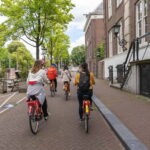
You’ll want to plan on riding your own bike. One rider advice is blunt: bring your bike, and be ready for a journey into neighborhoods outside the usual tourist traffic. If you normally ride a bike only at home, I’d still go—but I’d show up comfortable on city streets.
From Daniël Willinkplein to Olympiaplein: the 1943 Judenaktion stops
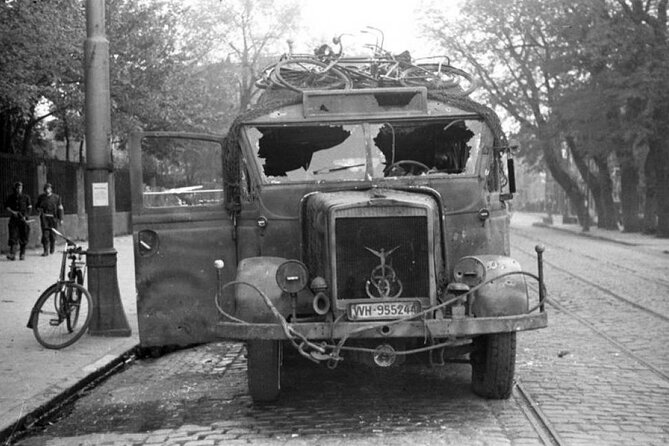
The story begins at Victorieplein, which was called Daniël Willinkplein during the war. Your guide sets the stage with a key date: June 20, 1943. This was the day of a major raid in Amsterdam, and the tour explains how large groups of Jewish residents were arrested during what the Nazis framed as the Judenaktion.
One reason this first segment works is that it names names and roles. You’ll hear about Dutch police units (PBA) and police volunteers linked to the NSB, then the process that moved people toward locations including Olympiaplein. From there, deportation continued to Westerbork in the east of the Netherlands.
As you bike, try to watch for something subtle: the tour keeps pulling you from a specific event to the street corner where it happened. You’re not just learning “WWII happened here.” You’re learning how the occupation worked step by step, block by block.
Anne Frank’s neighborhood trail at Merwedeplein and Waalstraat
Next, you shift to Merwedeplein 37-II (with note that American counting differs). This address was home of the Frank family. The tour points out the link between Otto Frank taking his family to Het Achterhuis (the Secret Annex) on the Prinsengracht and what followed from there.
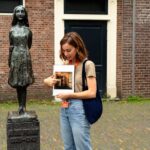
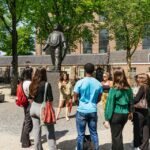
You’ll also see how the city memorializes this. A statue commemorates Anne Frank on Merwedeplein, and the route nudges you to connect the human story with the physical neighborhood you’re riding through. It’s personal history, but it’s also urban history—what life looked like around hiding places, offices, and daily routes.
Then comes one of the most moving “detail stops.” The tour goes to a bookstore on the Waalstraat side, tied to Jimmink. Around the corner from the shop, the tour explains that the first edition of Het Achterhuis was published in 1947. And here’s the diary connection: it was at this bookshop that Otto Frank bought Anne’s diary for his daughter.
That stop is a good example of why the bike format matters. You’re not stuck inside a single museum space. You’re walking the logic of the city—where stories started, where they were kept, and where they were later published and remembered.
Tilex Bar, PBA barracks, and Museumplein’s Nazi offices and bunkers
At Waalstraat 48, opposite Merwedeplein, the current spot is Café Blek. During the occupation it was the Tilex Bar—Tilly and Lex van Weren. The tour doesn’t just name the venue. It ties it to Lex van Weren’s fate, including the shocking detail that he survived Auschwitz because he had to play his trumpet at executions.
Expect this kind of stop to land hard. The tour’s strength is that it doesn’t sanitize the uglier parts of the occupation. It’s also balanced: it gives you context for the people and systems involved, not just a list of tragedies.
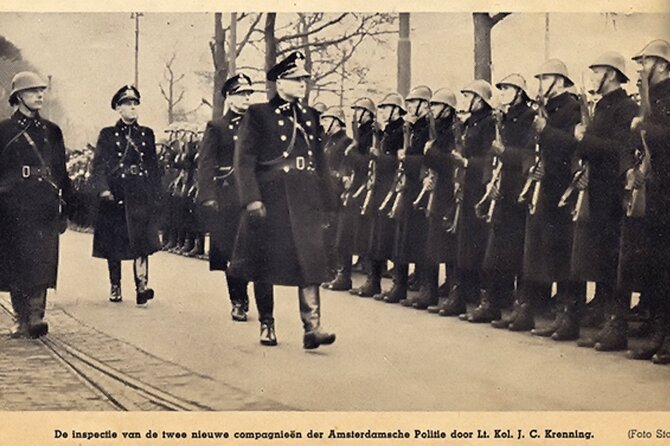
Next up is Cornelis Troostplein 23, which once accommodated the PBA barracks. Before WWII the site was known as a peace parish with a Catholic complex that held two convents and a school. Then in spring 1942, the tour describes an inspection by the Sicherheitsdienst/ Gestapo head Rauter and a meeting with SS leader Heinrich Himmler at Museumplein.
From there, you move to Museumplein, and this is where the tour becomes very architectural and very chilling. The Germans transformed Museumplein into a stronghold. On the left side facing the concert hall, the houses were used as German offices, including a building that housed the Zentralstelle für Jüdische Auswanderung (Central Jewish emigration office). The tour also calls out adjacent roles: the Ortskommandantur and the Feldgendarmerie.
Then you look at the larger military footprint. The skating club grounds (IJsclubterrein) became part of a fortified area with bunkers and flak batteries. The tour also points to the NSB HQ near the concert hall. After the war, the bunkers were blown up, but the stop still gives you a sense of how much infrastructure was hidden in plain sight.

Resistance photography at Roelof Hartstraat and memorials in plain sight
You’ll get a short break at Roelof Hartplein, with a stop for coffee and a restroom visit. The tour lists a free admission ticket for this segment, and it’s a chance to reset your brain before the next run of sites.
Then the history gets quietly intense again at Roelof Hartstraat. The tour explains there was a photo shop near the library building. During the war, Dutch resistance used the store and developed unique photos—images tied to the first roundup of Jews in Amsterdam by the SD/Gestapo and German police.
This stop is powerful because photography is one of those details that feels small until you realize what it meant. Records could be hidden, preserved, and later used to show what happened. And again, the bike route makes it feel real: you’re not imagining a photo darkroom in a vague warehouse. You’re in the neighborhood where it happened.
You’ll also see a small monument remembering Jews taken from this neighborhood. It’s brief, but it reinforces the tour’s rhythm: every big event gets a local anchor.
Executions and retaliation along Beethovenstraat and Euterpestraat
As you continue, the tour reaches the corner of Beethovenstraat and Apollolaan. Here it describes the end of October 1944, when SS officer Herbert Oelschlägel (also tied to Sicherheitsdienst/ Gestapo work) was executed by a Dutch resistance member.
The retaliation came fast. In response, the Sicherheitsdienst/ Gestapo burned down two houses and executed 29 resistance fighters. This is one of those stops where the street corner feels like it should be ordinary, but your guide makes it impossible to treat it that way.
The tour also notes that street names have shifted. At the time, Beethovenstraat was called Euterpestraat. And it connects the corner to Gerrit van der Veen, described here as the leader of an important Dutch resistance group.
I like how this section ties action to consequences. You’re seeing not only what the occupation did, but how resistance created risk for entire communities—and how occupiers punished that resistance to spread fear.
SD HQ, stolen-property offices, and RAF’s role near Rubensstraat
One of the most detailed stretches comes at the corner of Memlingstraat and Rubensstraat. The tour identifies two offices of key Nazi oppression organizations. One was SD HQ Amsterdam, described as an SD Außenstelle under Willy Lages. The other was the Hausraterfassungsstelle, focused on stealing possessions of deported Jews, part of the Zentralstelle für Jüdische Auswanderung.
The tour even gives you a named collaborator in charge of the stolen-goods office: Henneicke. It doesn’t stop at “this was bad.” It shows how systems had personnel and instructions.
Then the narrative turns to how resistance tried to fight back directly. In November 1944, the resistance requested the Royal Air Force via a secret radio message to attack the headquarters of the SD/Gestapo and the Hausraterfassungsstelle. Their main aim was destroying SD/Gestapo files.
You’ll hear the RAF detail too: the job was done by Group Captain Denys Gillam, DSO, DFC, AFC, leader of 149 (Typhoon) wing. That’s the kind of specific information that helps you picture the war beyond headlines.
Finally, the tour points out a safehouse area on the corner of Rubensstraat and Gerrit van der Veenstraat, and it tells you to check Stolpersteine for the address. It also describes a betrayal in June 1944 by a female informant referred to as V-Frau. This stretch makes it clear that in this part of Amsterdam, secrecy was fragile.
Olympiaplein registration, Luftwaffe HQ, and Queen Emma’s defiance
At Olympiaplein and Parnassusweg, the tour returns to the June 1943 raid. The story here is about registration. Jewish people arrested during the raid at the sports complex were registered by the SD/Gestapo, with help from Jewish camp police sent from Westerbork concentration camp.
That detail is tough, but it’s important context for understanding how the occupation used forced labor and coerced assistance inside its own machinery. The tour doesn’t ask you to ignore that. It keeps you oriented in the timeline.
Then you reach Valeriusplein and the Amsterdam Lyceum. This school building served as the Luftwaffe headquarters at the end of the occupation. It’s a stark reminder that education spaces weren’t immune; war infrastructure often repurposed what was already there.
Next is a more human-scale resistance symbol: a statue of Queen Emma on Emmalaan and Prins Hendriklaan. In summer 1940, people placed flowers at the statue in defiance of the German occupiers. Your guide also links back to a resistance photographer, Charles Breijer, whose photos included images of a Kriegsmarine headquarters guard in 1944.
This section gives you a necessary balance. You see both the bureaucratic and armed sides of occupation, and the smaller acts of defiance that built morale.
The final ride through Vondelpark and the meaning of May 7, 1945
The tour ends with the last days of the war in Amsterdam. When the Germans surrendered on May 7, 1945, the guide explains that dangerous situations arose between frustrated German troops and resistance fighters. The route includes a monument tied to victims of one of the shootings on that last day.
Then you bike through Vondelpark to Leidseplein, where you started. That closing loop does more than connect the route. It brings you back to the kind of Amsterdam people picture first—parks, paths, ordinary streets—while keeping the knowledge you’ve just picked up turned on.
If you’re the type who likes your history with location cues, this ending works well. You leave with a map in your head, not just memories of facts.
Value: what $66.09 buys you in context and conversation
At $66.09 per person for roughly three hours, you’re paying for three things that are hard to replicate on your own: expert guidance, tight storytelling, and the photo-based method. The mobile ticket helps keep things easy, but the real value is how the tour uses specific stops rather than vague “nearby landmarks.”
The small group size matters too. With max six people, you’re not stuck listening while the guide talks at full volume over your neighbor’s selfie stick. From the riders’ notes, Rudy and Peter guide with deep local ties and a lot of street-level context, including how the places connect to their own lived knowledge of the neighborhoods.
There’s also a quality-of-life advantage: cycling covers distance fast, and the south route helps you avoid constant center-grid crowd crush. You still get to see major historical anchors—Anne Frank-related addresses, places tied to the resistance, and occupation offices—without spending the whole day walking.
The emotional intensity is real, so I’d treat this as a focused history event, not background entertainment. If you can handle that, you’ll come away with a much sharper picture of how occupation systems worked in everyday Amsterdam.
Should you book this tour or choose something else?
I’d book this if you want WWII history that feels grounded in streets, not sealed behind museum glass. The combination of bike access to quieter areas, a max-six group, and WWII photos that match today’s locations is a strong formula for understanding.
I’d think twice if you’re sensitive to stories about arrests, deportations, and retaliation, or if you’re not comfortable riding a bike in an active city environment. But if you’re okay with that topic and you like walking away with a mental map of where events actually happened, this tour is a standout way to spend a half-day.
If your goal is to see Amsterdam through the lens of the occupation, Rudy and Peter’s route will give you that—clearly, steadily, and with enough detail to make it stick.
FAQ
Where does the Amsterdam in World War Two Cycle Tour start?
It starts at Tesselschadestraat 1, 1054 ET Amsterdam, Netherlands at 11:00 am.
How long is the bike tour?
The tour runs about 2 hours 30 minutes to 3 hours 10 minutes.
What group size is this tour?
The tour has a maximum of 6 travelers.
What language is the tour offered in?
It is offered in English.
Is a mobile ticket used for this tour?
Yes, you receive a mobile ticket.
How much does the tour cost?
The price is $66.09 per person.
What kinds of WWII sites will you see?
You’ll visit locations tied to WWII events in Amsterdam, including areas connected to the June 20, 1943 raid, the Frank family neighborhood, Dutch resistance activity, Nazi offices, and sites connected to the end of the occupation.
Will there be a break during the ride?
There is a short stop at Roelof Hartplein for coffee and a restroom visit.
What is the cancellation policy?
You can cancel for a full refund up to 24 hours in advance. If you cancel less than 24 hours before the start time, the amount you paid is not refunded.