REVIEW · AMSTERDAM
Amsterdam Pedicab City Tour (2 hours)
Book on Viator →Operated by Bram de Haan · Bookable on Viator
Amsterdam rewards people who slow down a little. This private pedicab tour gives you that slow-down feeling while still covering big sights fast. I like that you get local context, not just a checklist. I also like the practical style: frequent stops for photos, and time to ask questions without juggling a crowd.
What I’d pick as the main strength is the ride itself. A pedicab keeps you out of the thickest walking routes while you glide past landmarks like Dam Square, the Jewish quarter, and the canal ring. The second thing I really like is the guide’s storytelling style, especially with old maps/photos that help the city make sense.
One consideration: at two hours, the stops are short. You’ll see a lot, but if you want long museum time, this tour is more for orientation and viewpoints than deep visits.
In This Review
- Key highlights and what to expect
- Why a blue pedicab is a smart way to start in Amsterdam
- Pickup, timing, and how the 2 hours usually feel
- Your route: Dam Square to Museumplein in one smooth circuit
- Dam Square: where Amsterdam’s story begins
- Zeedijk and Chinatown: old dike streets and an older European Chinatown
- Nieuwmarkt: the old citygate and the layers around it
- Montelbaanstoren and the Amstel views
- Rembrandt’s house area: seeing the outside, not rushing the museum
- Jodenbuurt and the Portuguese Synagogue: Jewish quarter, survived and changed
- National Holocaust Names Monument: quiet impact in a short pass
- Museum connections: H’ART Museum and the Hermitage tie-in
- Magere Brug and the canal-ring photo setup
- Canal Ring (Grachtengordel): reading canal houses like a timeline
- Museumplein and the Rijksmuseum bicycle tunnel
- What’s included, what’s not, and where the value comes from
- Comfort on the ride: small details that matter
- Who should book this Amsterdam pedicab tour
- Should you book it for your trip?
- FAQ
- How long is the Amsterdam pedicab city tour?
- How much does the tour cost?
- Is this a private tour?
- Is pickup available, and where do I meet the guide?
- What language is the tour offered in?
- What’s included in the price?
- Are snacks included?
- Is the tour affected by weather?
- What are the tour’s main limits?
Key highlights and what to expect
- Private, up-to-2 group: It’s just you and your companion, with your guide steering the pace.
- Eco-friendly pedicab cruising: You cover major neighborhoods without tiring out on city sidewalks.
- Picture-friendly stops: The route is timed for viewpoints, bridges, and canal scenes.
- Big-city variety in 2 hours: From Dam Square to Museumplein, plus Jewish history and Chinatown.
- English mobile tour: Confirmation comes through at booking, and you’ll use a mobile ticket.
Why a blue pedicab is a smart way to start in Amsterdam
Amsterdam is gorgeous, but it’s also easy to feel like you’re sprinting. This pedicab tour fixes that by turning the first day stress into a calmer, seated city tour. You get a local guide’s focus while you move through several historic areas in one smooth arc.
The pedicab itself also changes how you experience streets. You notice details at street level, not just from a train window. And you can keep your attention on what matters, like the canal houses along the Grachtengordel (canal district) and the big sightlines around Museumplein.
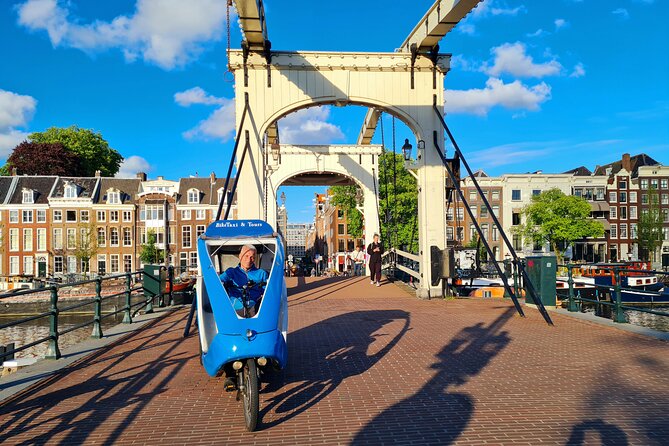
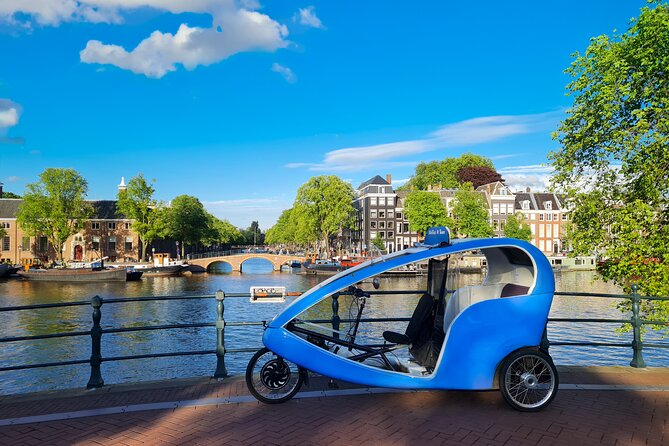
If you’re the type who hates wasting half a day figuring out logistics, you’ll appreciate the direct pickup. You wait in front of your hotel and look for the blue pedicab, then you’re off.
You can also read our reviews of more city tours in Amsterdam


Pickup, timing, and how the 2 hours usually feel
The tour runs about 2 hours, so think of it as a fast but human introduction to the center of Amsterdam. It’s private transportation, meaning you don’t share the pedicab with strangers or get stuck following someone else’s agenda.
You’ll get a mobile ticket, and the tour is offered in English. Most people can participate, but there are two practical limits to keep in mind: passenger weight is capped at 210 kg total, and there’s a maximum of one pedicab available per timeslot. Those constraints are normal for small-group, private-style tours, but they do matter if you’re traveling with multiple people or have tight scheduling.
Weather is another factor. The tour is described as requiring good weather, and if conditions are poor, you’ll be offered a different date or a full refund. If it’s rainy, plan for layers and bring something packable for your comfort.
Your route: Dam Square to Museumplein in one smooth circuit
This is a classic “big picture” route that still manages to include neighborhoods with very different vibes. You start at the city’s core, then work through older streets and crossings, and end in the museum area with iconic canal-and-architecture views.
The order matters because it builds context. Dam Square gives you the central starting point. Nieuwmarkt and the surrounding streets introduce the walled-city past. Then the route shifts into areas shaped by Jewish history and immigrant communities, before returning to the canal ring and Museumplein.
Your guide can also adjust stops for what you care about, including extra time for photos when you ask. That flexibility is often the difference between a tour that feels like a ride-by and one that feels like your day in Amsterdam.
Dam Square: where Amsterdam’s story begins
Dam Square is the main square and the heart of the old center. This is where Amsterdam began to evolve, and it’s where you’ll find big anchors like the Royal Palace area, the New Church, and the National Monument.
It’s a good first stop because it sets a baseline. If you’ve never been to Amsterdam, this square helps you understand the city’s layout before you start branching out. The tour keeps the stop brief, so your aim here is orientation and a couple of quick photos rather than a long hang.
Even if you know Dam Square already, it’s still worth seeing it from a pedicab perspective, because you can instantly connect it to the streets that come next—especially the older, narrower lanes.
Zeedijk and Chinatown: old dike streets and an older European Chinatown

Next you glide to Zeedijk, a street tied to one of the oldest dikes around the old center. It’s also where you can find one of Amsterdam’s oldest cafés, with an interior that keeps that ancient feel.
Then comes Chinatown. Amsterdam’s Chinatown is described as the oldest Chinese neighborhood of the European mainland. Here you’ll pass through a dense mix of restaurants, supermarkets, and a Chinese temple.
A quick stop can work here because the goal is atmosphere and recognition, not a deep shopping mission. If you like to “map” a city with your eyes, Chinatown’s contrast is useful. It makes Amsterdam feel like multiple cities layered on each other, not just one postcard.
If you’re sensitive to busy pedestrian traffic, you’ll like that the pedicab ride keeps you moving while you still see the neighborhood texture up close.
You can also read our reviews of more tours and experiences in Amsterdam



Nieuwmarkt: the old citygate and the layers around it
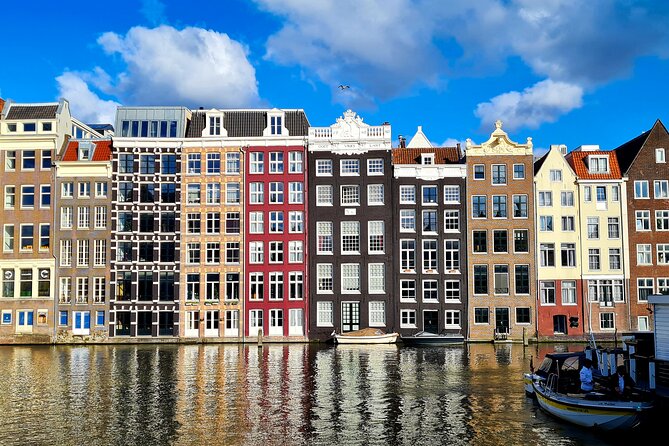
Nieuwmarkt is one of the important squares of old Amsterdam. In the middle of it, you’ll find the old citygate—what used to be the main entrance when Amsterdam was a walled, fortified city. After the big 17th-century expansion, that defensive layout became history, and the city spread outward.
This stop works well because it explains why so many streets feel like they’re built on older logic. When a guide connects the square to the city’s defensive past, the area stops feeling random.
It also gives you a pause before the more reflective stops later on. Think of it as the “okay, I get the timeline now” moment.
Montelbaanstoren and the Amstel views
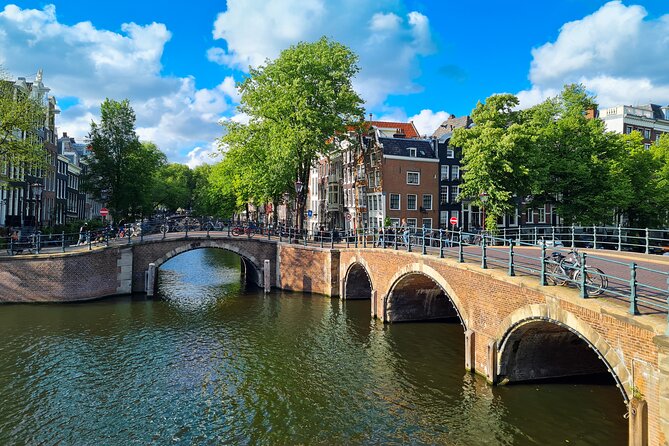
Montelbaanstoren is a historic ship watch tower tied to Amsterdam’s expanded defense line from the early 16th century. Even without climbing anything, it’s a strong landmark because it hints at how this city protected its waterways.
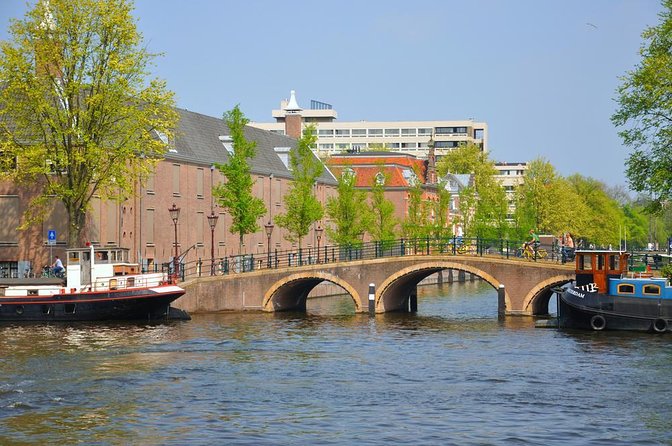
From here you also get a view over de oude Waal and the lined-up houseboats with classic canal houses in the background. This is one of those spots where you understand why Amsterdam’s canals matter so much. You’re not just looking at architecture; you’re seeing how the city lives with water.
This stop is short, but short doesn’t mean shallow. A well-timed viewpoint is often the best use of a limited tour window.
Rembrandt’s house area: seeing the outside, not rushing the museum
The tour includes an exterior look at Rembrandt’s house, where he lived during the successful years of his life. Entering the Rembrandt House Museum is possible, but it’s not included as part of this tour.
That’s a sensible approach. You get the connection to one of Amsterdam’s biggest names without forcing you to buy extra tickets or lose time. If you want the full museum experience, you can add it later based on your interests.
If you do care about art history, this is a good way to decide whether you want to spend longer later. The pedicab stop acts like a prompt, not a substitute.
Jodenbuurt and the Portuguese Synagogue: Jewish quarter, survived and changed
Then the route moves into Jodenbuurt, the older Jewish quarter. A lot of the center was altered after the Second World War, but key buildings, synagogues, houses, and streets remain. It’s an area where you can feel the city’s memory in the built environment.
After that, you pass the Portuguese Synagogue of Amsterdam. It’s the largest synagogue and among the earliest synagogues Western Europe allowed Jewish people to build in the late 1600s, with the building dated to 1675. You also see other synagogues opposite it, now connected to the Jewish Museum.
Two practical notes here. First, these are emotionally serious places, so keep your pace respectful and your photo-taking mindful. Second, since stops are brief, it helps to think of this segment as a guided orientation to place and meaning. You’ll get context even if you’re not going inside.
National Holocaust Names Monument: quiet impact in a short pass
You pass by the National Holocaust Names Monument. It uses 102,000 brick stones with names, meant to remind you of Dutch Jewish victims of World War II.
This is the kind of stop where time is less important than attention. Even as a quick pass, it leaves an imprint because the scale forces you to confront the magnitude of loss.
If you’re traveling with family members, it’s worth a moment of conversation here. Ask what each person wants to remember from the monument, rather than treating it like a box-check photo stop.
Museum connections: H’ART Museum and the Hermitage tie-in
You also pass the H’ART Museum, which is described as part of the Russian Hermitage Museum now. The building’s earlier identity is tied to a major home/care facility from the 17th century.
Because the tour is outdoors-focused at this stage, you’re not meant to get full museum context on-site. Still, these quick passes matter because Amsterdam museum culture is scattered. Seeing the building area gives you a better sense of where to go next if you add museum time later.
Magere Brug and the canal-ring photo setup
Magere Brug, the skinny bridge, is one of Amsterdam’s most iconic bridges. It’s also famous for its lights at night, which accentuate the bridge’s slender look. From here, you get a solid overview over the Amstel, which is both the main and widest canal in Amsterdam, and it’s a strong spot for photos.
Even during daylight, it works as a “reset” point. You’ve covered Jewish history, neighborhoods, and older defenses. Now you return to a classic canal view that feels like the Amsterdam postcard, but with a sense of where the city’s water traffic shaped life.
If you care about pictures, make sure you use this moment. Later, Museumplein has great views too, but bridges and rivers are often the shots you’ll frame.
Canal Ring (Grachtengordel): reading canal houses like a timeline
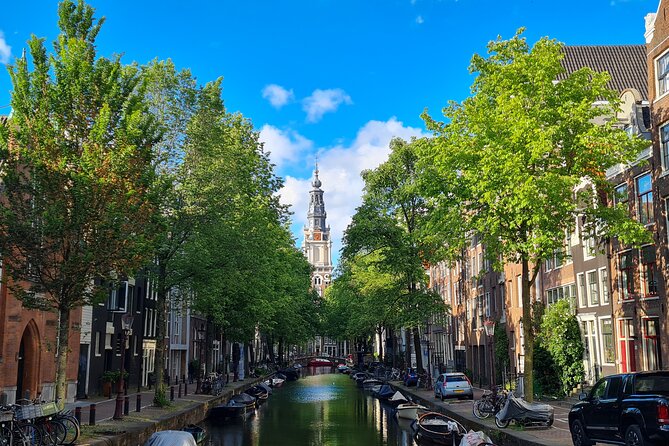
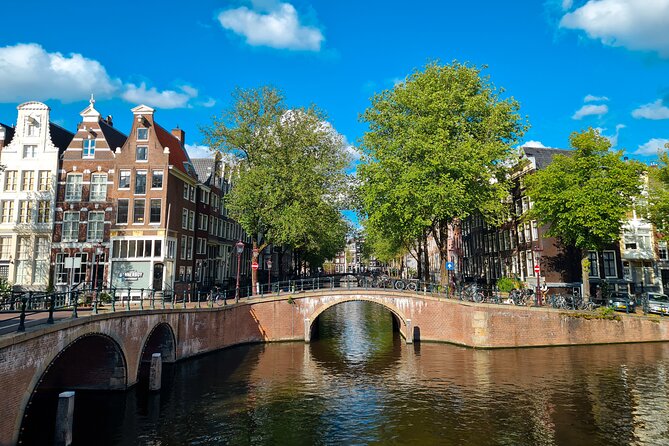
The canal ring is the 17th-century expansion area surrounding the old center. On maps, it shows up as half circles, and it’s where you’ll find many of the typical canal houses once owned by successful merchants.
The value here isn’t only the scenery. Your guide explains what makes many canal houses similar and what makes them differ, pointing to clues about when they were built. That turns a row of pretty façades into something you can actually interpret.
This is also where pedicab pacing pays off. When you’re not walking, you can keep your focus on details—brickwork, window styles, and how the buildings sit along the water.
Museumplein and the Rijksmuseum bicycle tunnel
Museumplein is the biggest and often the most impressive square in Amsterdam. On one side is the Rijksmuseum, and nearby you also have the Concertgebouw. Depending on your interests, you’ll also be near major museum brands like Van Gogh and Stedelijk, plus Moco and a Diamond museum.
In the tour, you stop here for views and context. It’s a great ending because it ties the city’s old prosperity to its modern cultural draw. You get to see why people dedicate days here, even if your time is limited.
A fun practical detail: you pass through the bicycle tunnel under the Rijksmuseum, where street-level music can sometimes be heard. Then you head toward Museumplein for a view of the back of the Rijksmuseum, completed in 1885 and designed by Pierre Cuypers.
That tunnel moment adds a slice of real Amsterdam rhythm. It feels like you’re moving through the city as it functions today, not just a museum zone.
What’s included, what’s not, and where the value comes from
You pay for private transportation on a pedicab. Snacks are not included, so if you tend to get hungry, plan for a small snack stop either before or after your tour.
Now, about value. At $237.65 per group (up to 2), you’re paying for two things that usually cost extra in Amsterdam: time and personalization. A private guide in a busy city means your questions get answered, your route can flex, and you’re not stuck in a big-group schedule.
That’s why this tour works best as an early orientation move. It can also be a smart pick if you’re limiting walking, traveling with someone who tires easily, or you want a first-day story that makes later museum visits feel more connected.
The guide name you’ll likely see associated with this experience is Bram de Haan. Many people highlight his way of pairing narratives with old photos and maps. That style is especially helpful in Amsterdam, where the city looks timeless but has changed fast over centuries.
Comfort on the ride: small details that matter
The pedicab is designed for close-up sightseeing without the strain of long walks. Getting on and off is described as easy, and your guide tends to stop often enough that you don’t feel like you’re trapped in motion.
Weather can be a factor, and one strong point is preparation. In cold or rainy conditions, people note that Bram brings comfort items like blankets. That small detail can turn an uncomfortable day into an actually enjoyable one.
You’ll also want to dress for Amsterdam wind and sudden weather shifts, especially since you’ll spend time outdoors moving between stops.
Who should book this Amsterdam pedicab tour
Book it if you want:
- A private, two-hour city orientation that covers major areas without exhausting walking
- A guide who connects landmarks to how Amsterdam grew and changed over time
- A mix of architecture, neighborhoods, bridges, and canal views, with Jewish history included on the route
This isn’t the best fit if you want long museum entries and lots of independent exploring during the tour itself. The tour isn’t built as an all-day deep dive, and not every site is entered.
If you’re traveling as a couple and want a memorable first impression of Amsterdam’s core, the pricing can feel reasonable because it’s per group, not per person, and because you’re paying for a custom pace.
Should you book it for your trip?
I think this is a strong choice when Amsterdam is your first European stop or when you only have a short time in the city. The route hits the kind of landmarks you’ll want to remember, and the private format makes it easier to ask questions and get clarity fast.
You should think twice if you need lots of indoor time during the tour, since some places (like Rembrandt House Museum) are mentioned as outside views and museum entry isn’t included. Also, if you hate weather-driven plans, pick your date carefully because the tour is described as requiring good weather.
If you’re the kind of traveler who likes to return later and say, I get it now, this pedicab tour is the kind of start that helps the whole trip click.
FAQ
How long is the Amsterdam pedicab city tour?
It runs for about 2 hours.
How much does the tour cost?
The price is $237.65 per group for up to 2 people.
Is this a private tour?
Yes. It’s a private tour/activity with only your group participating.
Is pickup available, and where do I meet the guide?
Pickup is offered. You wait in front of your hotel and look for the blue pedicab.
What language is the tour offered in?
The tour is offered in English.
What’s included in the price?
Private transportation is included.
Are snacks included?
Snacks are not included.
Is the tour affected by weather?
Yes. The experience requires good weather. If it’s canceled due to poor weather, you’ll be offered a different date or a full refund.
What are the tour’s main limits?
The maximum total passenger weight is limited to 210 kg, and there is a maximum of one pedicab available per timeslot.