REVIEW · AMSTERDAM
Amsterdam: Anne Frank Walking tour – Discover Her Story
Book on Viator →Operated by Tour Company B.V. · Bookable on Viator
Anne Frank lives in Amsterdam street corners. This 90-minute walking tour ties together the places around her life with the World War II story, using a guide who makes the setting feel real. I like that you hear more about Anne Frank’s life than you’d get from a typical guidebook.
I also like the format: a cap of 15 people keeps things personal, and the pace is easy to follow while you’re moving through the neighborhood. You get a professional guide in English, plus a mobile ticket that keeps the start simple.
One consideration: this tour is not recommended for people with walking problems. It’s a walking experience, and you’ll be outside for the full route.
In This Review
- Key Highlights You’ll Feel Immediately
- Price and Value: $17.75 for 90 Minutes of Story-Driven Walking
- Where You Meet and How the Tour Flows Through Amsterdam
- Nine Stops That Make the Story Feel Close: A Street-Level Timeline
- Stop 1: Merwedeplein 61 (Tour Start)
- Stop 2: Merwedeplein 37 (Where Her Family Lived Before Hiding)
- Stop 3: Jekerstraat 16 (Margot’s Jewish School)
- Stop 4: Geleenstraat 1 (The Ice Cream Stop That Changed)
- Stop 5: Niersstraat 41–43 (Anne’s Former School)
- Stop 6: Rooseveltlaan 62 (The Bookstore and the Diary)
- Stop 7: Lekstraat 61 (Synagogue Reference and Stars for Clothes)
- Stop 8: Hunzestraat 28 (Miep Gies and the Helpers)
- Stop 9: Merwedeplein 61 (Back to the Start)
- What the Guide Turns Into a Better Experience Than a Guidebook
- How This Tour Pairs With the Anne Frank House (Even If You Skip It)
- Who Should Book This, and Who Might Pass
- Should You Book This Anne Frank Walking Tour?
- FAQ
- How long is the Amsterdam Anne Frank Walking tour?
- What does the tour cost?
- Is the tour in English?
- What is the group size?
- Where does the tour start and end?
- What time does the tour start?
- Is the Anne Frank House entrance ticket included?
- Are the stops included with admission?
- Is a mobile ticket used?
- Is this tour suitable for people with walking problems?
Key Highlights You’ll Feel Immediately
- Small-group format (max 15): easier questions, tighter focus, less crowd noise.
- Stops tied to daily life: apartments, schools, a synagogue reference, and the people who helped.
- WWII context in plain language: you connect the dates to what happened around the corner.
- Smart value for the price: you pay less than many major attractions and still get deep context.
- A living city, not a museum set: some locations have changed, like the ice cream stop.
Price and Value: $17.75 for 90 Minutes of Story-Driven Walking
At $17.75 per person for about 1 hour 30 minutes, this tour lands in the sweet spot between a free neighborhood stroll and a big-ticket museum day. You’re not paying for a single building entrance. You’re paying for interpretation: a guide who turns streets you’d normally pass into a timeline you can actually follow.
What you get for the money matters. The tour includes a professional guide, all taxes and fees, and a small group size that helps your experience stay focused. The stops are free to visit in the sense that you’re not buying multiple admissions as part of the walk.
The main trade-off is what’s not included: there’s no entrance ticket to the Anne Frank House. So if you’re aiming to go inside that specific site, plan that separately. This walking tour shines as the context layer that helps everything make more sense when you encounter the major landmark later (or when you’re deciding not to).
You can also read our reviews of more walking tours in Amsterdam


Where You Meet and How the Tour Flows Through Amsterdam
You’ll meet back at Merwedeplein 61 (1078 NC, Amsterdam). The tour starts at 9:00 am and ends back at the same meeting point, so you don’t have to worry about figuring out a later transfer or a new end location.
The tour runs in English and uses a mobile ticket, which is handy when you’re juggling transit tickets and lunch plans. Since the route is near public transportation, you can usually slot it into a normal day without turning your schedule into a logistics puzzle.
Also note the pacing: stops are brief, usually around 10 to 15 minutes each. That’s long enough for the guide to give you context and keep you oriented, but short enough that you’ll stay moving and not get stuck in long standing lines.
If you don’t love walking, this is still manageable for many people, but it isn’t designed for strollers or limited mobility. The operator specifically notes it isn’t recommended for walking problems, so be honest with yourself about how your legs will feel by the end.
Nine Stops That Make the Story Feel Close: A Street-Level Timeline
This is a neighborhood walk through the areas connected to Anne Frank and the people around her. Expect the guide to point out what happened where, and why these specific sites mattered.
You’ll start with a light introduction at the first spot, then gradually move through schools, a bookstore, a synagogue reference, and finally the home linked to a helper from the Secret Annex story. By the time you reach the end, you’ll see the whole period as something that played out in normal city routines, not just in history books.
Stop 1: Merwedeplein 61 (Tour Start)
This is where the story gets framed. You’ll get the “how to read the neighborhood” part first, so when you later see a school building or a storefront, you’ll know what to connect it to.
Even though this start point isn’t described as a specific single event site, it helps set up the rhythm of the walk. The guide uses the surrounding streets as cues, so you don’t just memorize addresses.
Stop 2: Merwedeplein 37 (Where Her Family Lived Before Hiding)
Here, the tour connects the dots between the period before hiding and the later Secret Annex years. This is the location where Anne Frank lived with her family before they went into hiding in the secret annex.
This stop works well because it anchors the story to something concrete: a place people could walk past daily. If you’ve only ever encountered Anne Frank’s story through book covers, this is where the city starts feeling like part of the narrative.






Stop 3: Jekerstraat 16 (Margot’s Jewish School)
At Jekerstraat 16, you’ll learn about Margot Frank and the Jewish school she attended. Margot’s schooling is a reminder that the Franks weren’t just “waiting for history.” They were living real days with real routines, including school.
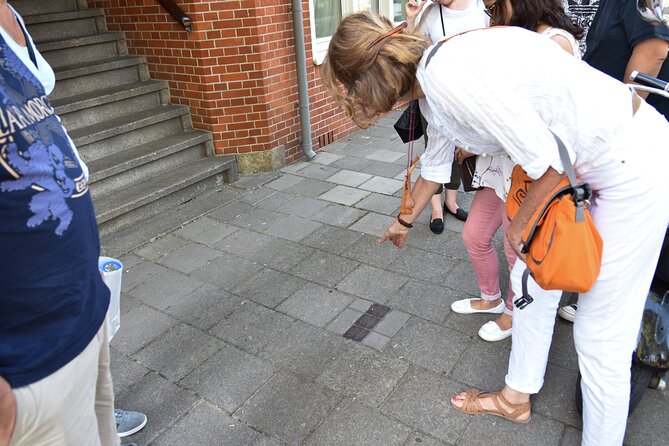
This is also a good stop for understanding how persecution affected ordinary life. It’s one thing to hear that Jews were restricted; it’s another to hear it connected to where children went to learn.
Stop 4: Geleenstraat 1 (The Ice Cream Stop That Changed)
One of the most memorable parts of the tour is the ice cream connection at Geleenstraat 1. The ice cream salon described as part of Anne’s circle does not exist anymore. Today, the building houses a Japanese/Peruvian restaurant.
Still, the story hasn’t vanished. The wall includes a large painted portrait of Anne, and that detail helps you picture what the neighborhood must have felt like to her and her friends during those years when life included small joys like ice cream.
This stop is a great lesson in how cities evolve. Some sites disappear. Some are repurposed. And sometimes, a visual reminder is all that’s left to keep the past from turning into an abstraction.
Stop 5: Niersstraat 41–43 (Anne’s Former School)
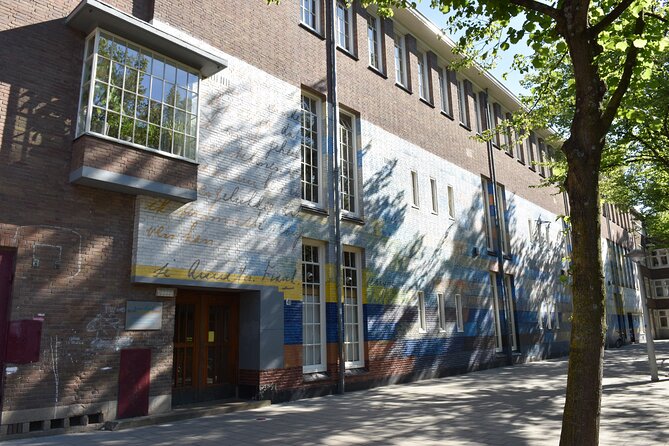
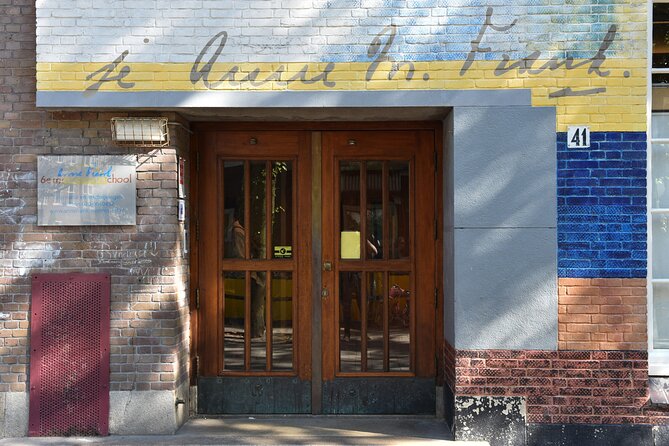
At Niersstraat 41–43, the tour points to Anne Frank’s school—described here as the former 6th Montessori school.
A school stop can go either way on a walking tour: it can become a facts-only detour. Here, it’s better because it ties education to identity and time. You’re seeing how Jewish life, schooling, and neighborhood geography intersected during the years leading up to hiding.
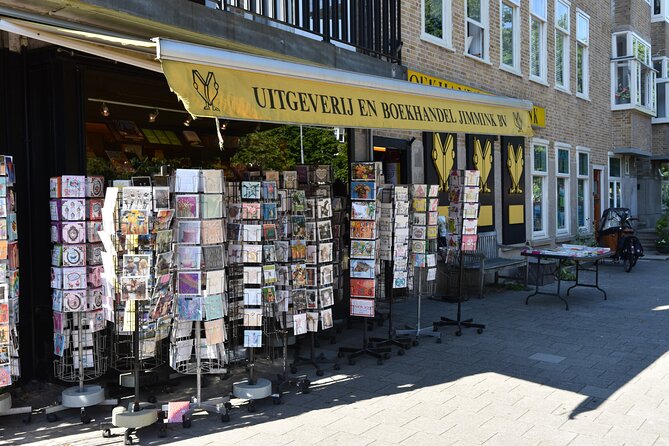
Stop 6: Rooseveltlaan 62 (The Bookstore and the Diary)
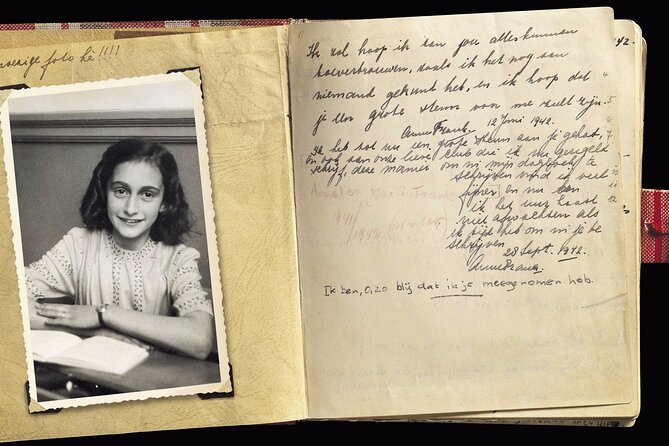
At Rooseveltlaan 62, you’ll visit a bookstore site connected to Otto Frank buying Anne’s diary. The tour frames this as the store where her father purchased the diary together with her.
Even if you’ve read about the diary, connecting it to a place you can stand outside helps it feel more grounded. It shifts the diary from being a famous artifact to being something Anne started writing at a moment tied to a specific part of the city.
If you’re a first-time Anne Frank visitor, this stop is especially important because it helps you understand that her words came from daily life—before hiding turned everything upside down.
Stop 7: Lekstraat 61 (Synagogue Reference and Stars for Clothes)
At Lekstraat 61, you’ll stop at a synagogue-related location where the tour notes Jews bought stars for clothes.
This kind of stop adds a sharper edge to the tour. It’s not “cute history.” It’s a concrete reference to Nazi-imposed restrictions that reached into clothing and daily routine. The guide’s job here is to keep it understandable and not overly abstract.
This is also where you’ll likely feel the emotional weight of the tour most clearly—because it points to how control showed up in small, practical ways.
Stop 8: Hunzestraat 28 (Miep Gies and the Helpers)
At Hunzestraat 28, you’ll hear about the house of Miep Gies. Miep is described as an employee of Otto Frank and one of the helpers connected to the people in hiding in the Secret Annex.
This stop balances the story. Instead of focusing only on Anne’s perspective, it brings in the network of people who helped. It’s a reminder that survival and secrecy weren’t solitary acts; they depended on others willing to risk something.
If you prefer historical stories that include the human choices around the edges, this is a strong emotional payoff.
Stop 9: Merwedeplein 61 (Back to the Start)
You end back at Merwedeplein 61. That return matters more than it sounds: you finish where you began, so your day stays simple. It also lets the guide do a quick wrap-up that ties earlier stops to the larger timeline you just walked through.
By the time you leave, you’ll have a mental map of names, streets, and connections. That’s the real value of a walking tour like this: you don’t just learn facts. You learn geography.
What the Guide Turns Into a Better Experience Than a Guidebook
A guide can’t change what happened. But a good guide can change how well you remember what happened.
On this tour, the big advantage is the delivery. The guide’s style is described as kind, professional, and enthusiastic, and the tour focuses heavily on Anne Frank’s life and the surrounding history of her family. That combination matters because Anne Frank’s story is widely known, but details about her neighborhood life aren’t.
The best part is how the guide helps you connect layers:
- a street address
- a school or building type
- a family member (like Margot)
- and a broader WWII reality (like the synagogue reference and clothing star mention)
If you’ve ever felt lost when reading about Anne Frank—too many names, too much background—this format gives you a path through it. It’s also easier to ask questions because the group is capped at 15.
How This Tour Pairs With the Anne Frank House (Even If You Skip It)
Since admission to the Anne Frank House isn’t included, you have choices.
If you plan to visit the Anne Frank House separately, this walk can act like your warm-up. You’ll leave with clearer context about the surrounding neighborhood sites tied to schools, daily life, and the diary story. That often makes a later visit more meaningful because you’ve already built the mental framework.
If you don’t plan to go inside the Anne Frank House, the trade-off is that you’ll still get story-driven context without committing to a specific ticketed attraction. You’ll be outdoors, you’ll cover multiple locations, and you’ll walk away with a stronger sense of how her life connected to the city around her.
Either way, you’re not wasting time. You’re choosing a different angle on the same story.
Who Should Book This, and Who Might Pass
This tour is a strong fit if you want:
- a focused Anne Frank and WWII experience that fits into a morning or part of a day
- a small-group atmosphere where you can actually listen
- a street-level way to connect schools, daily routine, and the helpers connected to the Secret Annex story
You should think twice if:
- you have walking limitations (the tour is explicitly not recommended for people with walking problems)
- you only want major attraction entrances. This is a context walk, not a multi-museum ticket bundle
It’s also a good pick for people who like seeing how history sits inside modern streets. You’ll learn that some locations change completely, like the ice cream stop that became a restaurant, and yet the story still leaves traces.
Should You Book This Anne Frank Walking Tour?
I’d book it if you want a simple, affordable way to understand Anne Frank’s life in Amsterdam beyond a single landmark. For $17.75, you get a tight 90-minute route, a professional guide, and a neighborhood timeline that makes the story easier to follow.
Skip it only if your mobility is limited or if you’re specifically chasing the Anne Frank House entrance itself. In that case, book the house separately and use this walk only if you still want street-level context.
If your goal is to leave Amsterdam feeling you understand the city behind the headlines, this tour is a smart use of time.
FAQ
How long is the Amsterdam Anne Frank Walking tour?
It runs for about 1 hour 30 minutes.
What does the tour cost?
The price is $17.75 per person.
Is the tour in English?
Yes, it is offered in English.
What is the group size?
The tour has a maximum of 15 travelers.
Where does the tour start and end?
It starts at Merwedeplein 61 (1078 NC Amsterdam) and ends back at the same meeting point.
What time does the tour start?
The listed start time is 9:00 am.
Is the Anne Frank House entrance ticket included?
No. Entrance ticket to Anne Frank House is not included.
Are the stops included with admission?
The stop notes indicate admission ticket free for the locations on the walk.
Is a mobile ticket used?
Yes, the tour uses a mobile ticket.
Is this tour suitable for people with walking problems?
It is not recommended for people with walking problems.