Skip the main drag and start smart. On this private “hidden streets” walk, I like how guides such as Christian or Michael steer you away from the heaviest tourist lanes and into calm courtyards and lesser-known corners of the city. You get story and direction together, so the time feels useful instead of like wandering.
I also like the sharp way the tour grounds you in Amsterdam’s origin story, including lessons about the world’s first stock market at Beursplein and how the central square and nearby town-hall-era building shaped the city. You’re not just taking photos; you’re learning what you’re looking at, which makes the rest of your stay easier to plan.
One consideration: you’ll walk about 2.5 hours over roughly 4 km (2.5 miles), and the tour ends at Elandsgracht rather than at your starting point. If you’re not into a steady stroll, plan your shoes and transport ahead.
In This Review
- Key highlights worth choosing
- Starting at Beursplein: stock-market origins and a square that mattered
- Crossing the Canal Ring: how medieval Amsterdam stretched out
- The quieter nine streets: shopping that doesn’t feel like a stampede
- Jordaan hidden lanes: authentic neighborhood energy (and good stories)
- Karthuizerhof courtyard: widows’ social housing from 1650
- Westerkerk and Rembrandt’s burial: a church stop with weight
- The private format: why “only your group” changes the whole experience
- Price and what you really get for $101.15
- Practical tips so the walk feels easy, not exhausting
- Should you book this hidden streets private tour?
- FAQ
- How long is the hidden streets private tour in Amsterdam?
- Where does the tour start and where does it end?
- Is this tour private?
- What language is the tour offered in?
- What sights or areas will I see during the walk?
- Do I need admission tickets for stops?
- What is the cancellation policy?
Key highlights worth choosing
- Beursplein context first: the world’s first stock market plus the central square’s significance to set the stage
- Quiet canal-ring time: a focused cross of the canal ring that explains how the city expanded in medieval times
- Shopping lanes away from the masses: nine streets that feel more local than touristy
- Jordaan’s hidden streets and squares: a look at an Amsterdam neighborhood that still has an everyday feel
- Karthuizerhof courtyard for widows (1650): early social housing history you won’t find on a rush-only tour
Starting at Beursplein: stock-market origins and a square that mattered
Most Amsterdam walks start with canals and end with canals. This one starts with why Amsterdam worked, at Beursplein (Beursplein 1-3), right in the city’s commercial heartbeat. You begin with the origins of Amsterdam and you’ll learn about the world’s first stock market—an eye-opener because it explains how a city known for trade and canals also built its power through finance. The history doesn’t sit in the clouds. It lands on the square where you’re standing.
From there, the tour connects the dots around the central square and then points out a fascinating building that originally served as the town hall of Amsterdam. That detail matters because it changes how you read the architecture around you. Instead of seeing “a historic-looking building,” you start seeing civic power, decision-making, and the practical machinery of a growing city.
This first section is also where you’ll feel the advantage of having a private guide. In a crowd tour, you often just chase the next stop. Here, you get a real sense of orientation—what’s important, what’s symbolic, and what to look for as you move.
You can also read our reviews of more private tours in Amsterdam


Crossing the Canal Ring: how medieval Amsterdam stretched out
After the Beursplein intro, you cross the Canal Ring of Amsterdam. This isn’t a lecture-only moment. You’re walking through the web of canals that helped define the city’s form, and your guide explains how Amsterdam extended during medieval times. That’s a crucial thread: once you understand the city grew outward in planned ways, the canals stop being just a pretty backdrop.
A canal-ring stroll also gives you quick visual cues that help you later. You start noticing the rhythm of building lines, the way the canals carve neighborhoods, and how bridges and crossings shape movement. Even if you’ve seen the canal ring from a distance, this perspective makes it feel more like an urban system than a postcard.
Timing helps here too. This part is set up as a roughly one-hour stretch, with admission marked free on the itinerary. So it’s the kind of stop where you can focus on observation and explanation without feeling like you’re paying to step into yet another indoor museum.
The quieter nine streets: shopping that doesn’t feel like a stampede
Then comes a change of pace: the nine streets that have turned into a cozy shopping area, away from the worst of the tour crowds. This is where the tour becomes more lifestyle than textbook.
The overall experience highlights include an antique market and trendy coffee shops. Even if you’re not shopping, this section helps you understand Amsterdam’s daily texture—how people move, browse, and linger in smaller pockets instead of only in the big, famous streets.
I like this part because it teaches you a practical rule for Amsterdam: if you only go where the crowds are, you miss the city’s rhythm. Here, your guide steers you to lanes where it’s easier to slow down, look around, and get a feel for what you might want to repeat on your own later.
Jordaan hidden lanes: authentic neighborhood energy (and good stories)
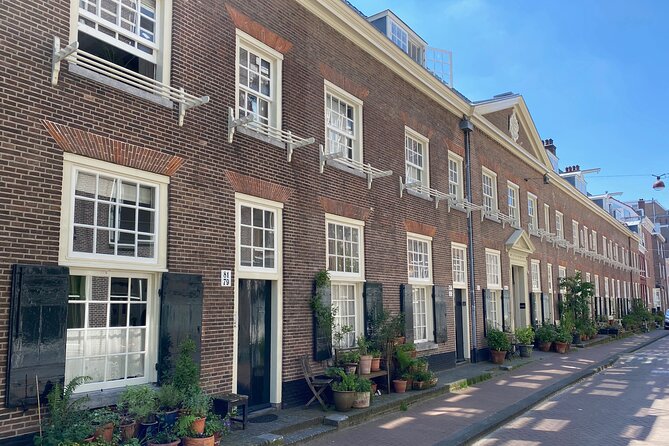
Next you spend about 1 hour 20 minutes in the Jordaan, a neighborhood known for keeping more of its everyday identity than the flashier central corridors. The tour focuses on hidden streets and squares, and that phrasing is spot-on. You’re not just walking past landmarks. You’re being shown why this area feels different—smaller spaces, quieter corners, and the sense that people actually live around you.
Jordaan is also where the tour becomes richly “walk-and-talk.” You’ll learn why certain buildings ended up exactly where they did, including a stop centered on the church for the poor. The guide explains the motivation behind its construction, which gives the building a purpose beyond its exterior look. That’s what turns a street sight into a story you remember.
While you’re in the Jordaan area, you’ll also pass by the Anne Frank House during the stroll. This is valuable even if you don’t schedule tickets separately. Seeing it as part of a neighborhood route helps you understand it as something embedded in streets and life—not just a standalone museum stop.
If you’re visiting Amsterdam for the first time, this section is one of the best ways to connect the city’s past to its present feel. You’ll start spotting patterns you can later recognize on your own walks.
Karthuizerhof courtyard: widows’ social housing from 1650
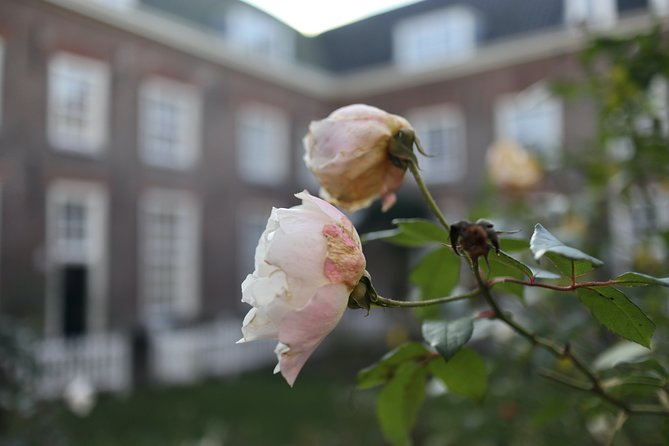
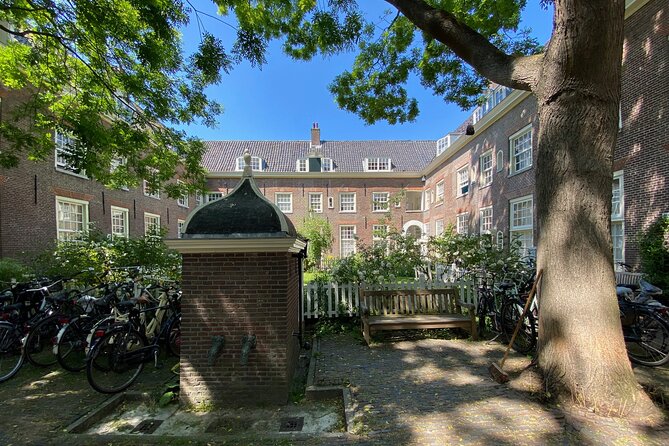
One of the most memorable parts is Karthuizerhof, a beautiful courtyard constructed in 1650 for widows. This courtyard is described as one of the first social housing projects in the world, and that detail changes how you see the space immediately.
Courtyards like this don’t just look charming. They were practical solutions to real problems, and they reflect an Amsterdam that cared about social needs through design. In about 10 minutes, you get the context, then you stand in the place and let it sink in. It’s the kind of stop that makes you stop checking your phone and start noticing lines of light, brickwork, and the quiet geometry of the courtyard.
This also shows the tour’s real theme: Amsterdam’s most interesting moments often hide in plain sight behind unremarkable entrances. A courtyard is basically the city saying, look closer.




Westerkerk and Rembrandt’s burial: a church stop with weight
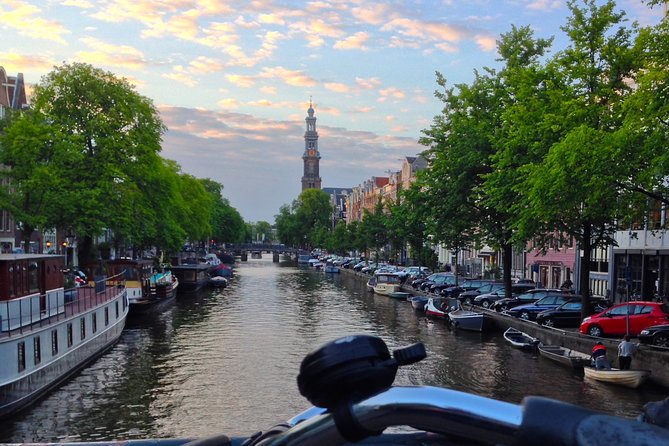
Toward the end, the tour brings you past the Westerkerk. This church is described as a marvel, and you’ll hear about Rembrandt being buried there. That’s an important detail because Rembrandt often gets discussed in art terms; here, you connect him to a specific place in the city.
Even if you don’t go inside, the stop gives you a sense of how Amsterdam’s art history is anchored in civic spaces. Your guide’s explanation helps you place the church in the wider story of the city—who mattered, where they were remembered, and how communities built landmarks that outlasted individual lives.
This part also helps pacing. After streets, squares, and courtyards, the Westerkerk stop gives you a visual pause point. Churches tend to make people quiet without trying.
The private format: why “only your group” changes the whole experience
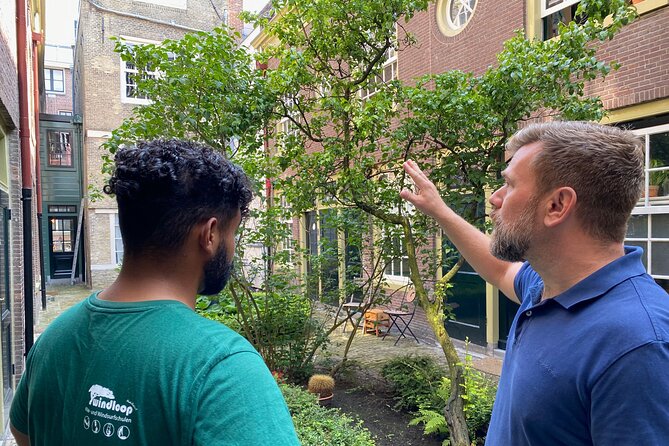
This is a private tour/activity, meaning only your group participates. That sounds like a marketing line, but it matters in practice. It means the guide can keep the pace aligned with your interests instead of rushing to match a fixed group flow.
The tour is offered in English and comes with a mobile ticket. There are multiple start times too, which helps if you’re trying to fit Amsterdam sightseeing around museum tickets, canal cruises, or simply rest breaks (yes, Amsterdam walking adds up fast).
You also get tailored recommendations for the rest of your vacation. That part is where value often shows up. After a route like this, you’re not just “done with a tour.” You leave with a clearer game plan for where to spend your remaining time—places that match your newly understood Amsterdam mood: quieter, local, and historically grounded.
In the feedback, Christian and Michael are repeatedly praised for being friendly and passionate, and for showing sights that most people don’t find on their own. The best private guides don’t only point at objects; they teach you how to read the city. That’s exactly the vibe here.
Price and what you really get for $101.15
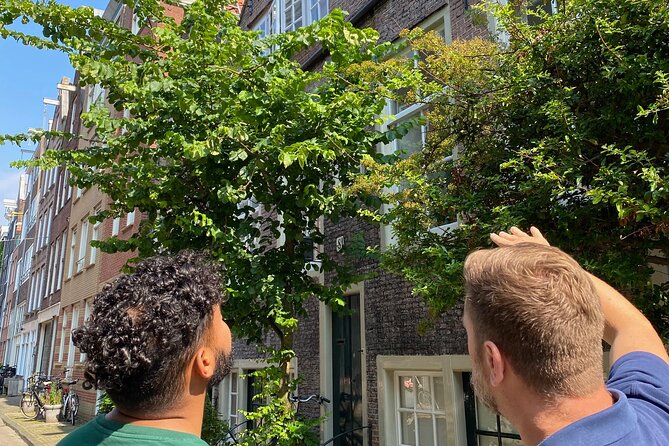
At $101.15 per person for about 2 hours 30 minutes, this isn’t the cheapest way to see Amsterdam. But the pricing makes sense if you compare what you get: a private, guided route that focuses on less crowded streets, courtyard architecture, and context-rich history tied to real locations.
A couple reasons the value feels solid:
- Many stops are marked admission ticket free on the route, so you’re mostly paying for the guide and the time together—not for a chain of paid entries.
- You’re getting a route designed to help you understand Amsterdam quickly, then act on it later with tailored recommendations.
- The private format reduces the usual “hurry up and wait” frustration, since you’re not stuck in a big group rhythm.
Also, because it’s priced per person, your best value depends on your group size and flexibility. If you have a small group of friends or family, this can feel like a good deal. If you’re traveling solo, it may cost more relative to group tours—but you still get that custom pacing and quiet-streets focus.
Practical tips so the walk feels easy, not exhausting
This tour is about a 2.5-hour walk covering around 4 km (2.5 miles). That’s a comfortable distance for many people, but it’s still city walking. Do yourself a favor and wear shoes you’d use for a full morning in town.
A few other practical points that help:
- Plan for the end point at Elandsgracht. You’ll want a tram/bike plan or a nearby destination in mind before you start.
- Bring layers. Amsterdam weather changes faster than your train announcements.
- If you’re hoping to visit the Anne Frank House inside, treat the pass-by as orientation, not a ticket substitute. The route helps you understand where it sits in the neighborhood.
If you like history that connects to streets and daily life, this fits you well. If you only want to tick off famous monuments in a rush, you might find it too story-focused and too “slow down and look” in places.
Should you book this hidden streets private tour?
I’d book this if you want Amsterdam with fewer crowds and more context. It’s especially worth it if you care about how the city formed—stock-market origins, town hall-era civic power, medieval canal growth, and social housing history at Karthuizerhof. It’s also a smart pick for people who enjoy small surprises: courtyards, quieter squares, and street-level Amsterdam that feels lived in.
I wouldn’t book it if your main goal is purely big-ticket attractions with minimal walking. This experience is about pace, stories, and the texture of neighborhoods like the Jordaan. If that sounds like your Amsterdam style, you’ll likely have a great time.
FAQ
How long is the hidden streets private tour in Amsterdam?
The tour lasts about 2 hours 30 minutes, with walking for roughly 2.5 hours over about 4 km (2.5 miles).
Where does the tour start and where does it end?
It starts at Beursplein 1-3, 1012 JW Amsterdam, Netherlands, and ends at Elandsgracht, Amsterdam.
Is this tour private?
Yes. It is a private tour/activity, so only your group participates.
What language is the tour offered in?
The tour is offered in English.
What sights or areas will I see during the walk?
You’ll learn about Amsterdam’s origins at Beursplein, cross the Canal Ring, visit quieter nine streets for shopping, explore the Jordaan’s hidden streets and squares, see Karthuizerhof courtyard, pass by the Anne Frank House, and visit the Westerkerk area linked to Rembrandt.
Do I need admission tickets for stops?
The itinerary lists admission ticket free for key parts, and the tour uses a mobile ticket. Any paid entry needs are not specified for every stop, so check your confirmation details when you book.
What is the cancellation policy?
Free cancellation is available if you cancel up to 24 hours in advance of the experience start time, based on local time.