REVIEW · AMSTERDAM
Amsterdam Highlights Small-Group Walking Tour
Book on Viator →Operated by Amsterdam Guías & Tours · Bookable on Viator
Amsterdam has a lot to say, if you listen. This small-group walking tour strings together the city’s major landmarks and lesser-known corners, with stories that go past the usual photo stops. I love the personal attention you get with a max group of 10, and I also like that you can add an optional 1-hour canal cruise ticket for an easy, relaxing finish. One thing to plan for: some parts can be loud or busy, so you may need to stay close to your guide if you want to catch every word.
This is built for a quick “get your bearings fast” day. You’ll walk for about 2 to 3 hours, starting at Beursplein and ending at Dam Square, with your guide handling the route and the talk in English.
The route itself feels like Amsterdam in miniature: trade and architecture up front, then Chinese Quarter temples, the Jewish Quarter and World War II history, flower-market squares, and finally the big civic heart around the Royal Palace and National Monument.
In This Review
- Key highlights you’ll actually feel on the streets
- Why this route fits Amsterdam’s walking style
- Finding your guide at Beursplein (look for the blue umbrella)
- Beursplein: trade, the stock exchange, and the feel of money
- Amsterdam Centraal: Pierre Cuypers’ 1889 station in context
- Chinese Quarter and the Buddhist Temple: a different Amsterdam layer
- Nieuwmarkt and San Antón Gate: the old market edge
- Jodenbuurt: Jewish Quarter and World War II history
- Muntplein and the flower market: pretty with a point
- Begijnhof Gardens: quiet refuge in the middle of the city
- Dam Square finale: Royal Palace, Nieuwekerk, National Monument
- Optional 1-hour canal cruise: why it works after the walking
- Price and value: $24.08 for a guided, multi-neighborhood story
- Who should book this tour, and who might want a different fit
- Should you book the Amsterdam Highlights small-group walk?
- FAQ
- How long is the Amsterdam Highlights small-group walking tour?
- What is the price per person?
- What language is the tour offered in?
- How big is the group?
- Where does the tour start and end?
- Which major places are included in the route?
- Is an optional canal cruise included?
- Are tickets or admissions needed for the stops?
- What’s included in the cost?
- Is food and drinks included?
Key highlights you’ll actually feel on the streets
- Max 10 travelers means fewer people to wait for and more chances to ask questions
- A route that connects Centraal Station to the Jewish Quarter without feeling like a checklist
- Stops like Muntplein and Begijnhof give you both “pretty Amsterdam” and quiet pockets
- The guide’s style can be fun and interactive, not just lecturing
- Optional add-on: a 1-hour canal cruise ticket that helps you process what you saw on foot
- Free entry at key sights along the way, so you’re paying for the guide, not museum time
Why this route fits Amsterdam’s walking style
Amsterdam rewards pedestrians, but it also rewards focus. This tour is paced for city-center walking: short introductions, frequent regroup points, and transitions that keep you moving through different neighborhoods without burning the day out.
That small-group size matters. When you’re with more people, you spend time trying to “find the guide” again and again. With up to 10, it’s easier to stay with the group, hear what’s important, and get the kind of city context that only shows up when your guide can read the room. If you like tours where you can ask something real—architecture, daily life, why things are laid out the way they are—this format helps.
Also, the itinerary choice is smart. You get major landmarks (like Amsterdam Centraal and Dam Square) plus the “middle layer” neighborhoods that you’d miss if you just hop between museums. That mix makes it a great first trip, or a second-day tour when you want depth without committing to a full museum afternoon.
One caution: some reviews mention hearing issues when there isn’t a headset/microphone setup. That doesn’t mean it will be bad every time, but it does mean you should position yourself near the front and be ready for street noise in squares.
You can also read our reviews of more walking tours in Amsterdam


Finding your guide at Beursplein (look for the blue umbrella)
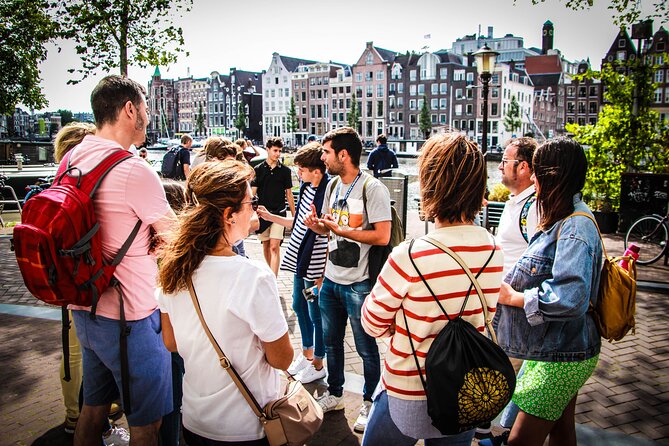
You’ll start at Beursplein (1012 JW Amsterdam). The guide meets you in a specific spot: in front of Cafe Bistro, near the bull figure, with either a blue umbrella or a tag with the Amsterdam Guides & Tours logo.
This is the kind of detail that saves time and stress. Amsterdam’s central squares are busy, and even being 2 minutes late can turn into a messy “where are you?” moment. So arrive a bit early, stand where you can spot that blue umbrella, and take a quick look around before the group forms.
You’ll end at Dam Square, which is a great landing zone. It’s central, it’s easy to orient from later, and it puts you right where you can keep exploring—shopping, canals nearby, and plenty of cafes once you’ve walked off the first wave of history.
Beursplein: trade, the stock exchange, and the feel of money
You begin at Beursplein, called that because it sits next to the stock exchange. Even if you’ve never cared about finance, this is a good starting point because it frames Amsterdam’s identity: a city shaped by trade, shipping, commerce, and global connections.
The value here isn’t “facts for facts’ sake.” It’s the way the guide connects the physical city to the bigger story. Beursplein gives you a commercial starting line, so later neighborhood contrasts make more sense. When the tour moves from trade to streets with deeper wartime history, you’ll feel the contrast more clearly.
And since the tour is short, the Beursplein intro sets the tone quickly. It helps you understand what you’re seeing—buildings, street layouts, and why certain areas became important.
Amsterdam Centraal: Pierre Cuypers’ 1889 station in context
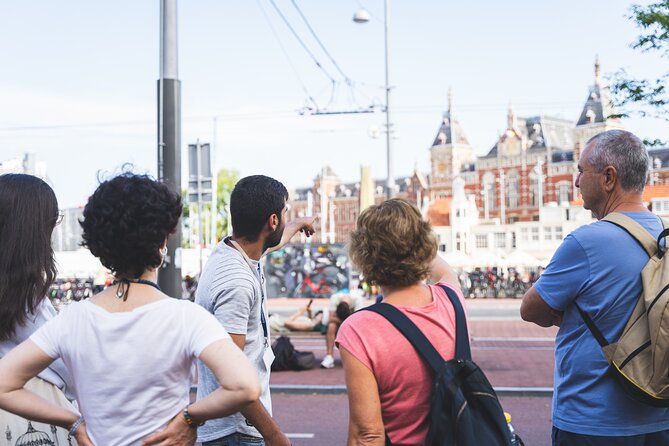
Next comes Amsterdam Centraal, opened in 1889 and designed by Dutch architect Pierre Cuypers. It’s also the city’s largest railway station and main hub, so it’s more than just architecture—it’s Amsterdam in motion.
What you should watch for as you’re standing around the station: the way a grand civic building can work like a gateway into the city. Centraal feels monumental even when you’re just passing through, but a guided walk helps you see it as part of the city’s growth—not only as a transit stop.
You’ll also appreciate this timing. Starting at Centraal keeps the route anchored to a major landmark, so you’re less likely to feel “lost in alleys.” From there, the tour shifts into older neighborhoods and smaller streets.
Chinese Quarter and the Buddhist Temple: a different Amsterdam layer
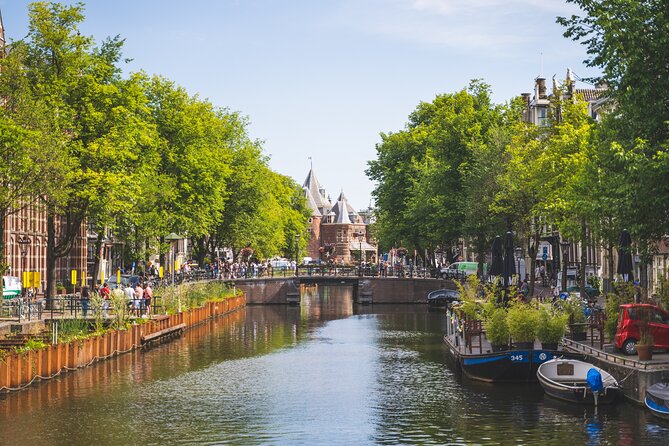
As you continue, you’ll walk through the Chinese Quarter and visit the Buddhist Temple of Amsterdam. This stop is valuable because it shifts the story away from only 17th-century canal legends and royal palaces.
Amsterdam isn’t stuck in one era, and this portion makes that clear. A temple stop also changes the mood of the walk. Even if you’re not religious, you’ll likely notice how the area feels different from the main squares—more intimate, more local, more about living communities than sightseeing crowds.
You may also like this section if you enjoy cultural contrasts. The tour keeps moving, but this stop gives you a real “Amsterdam is layered” moment, so the later historical sections don’t feel like one long grim lecture.





Nieuwmarkt and San Antón Gate: the old market edge
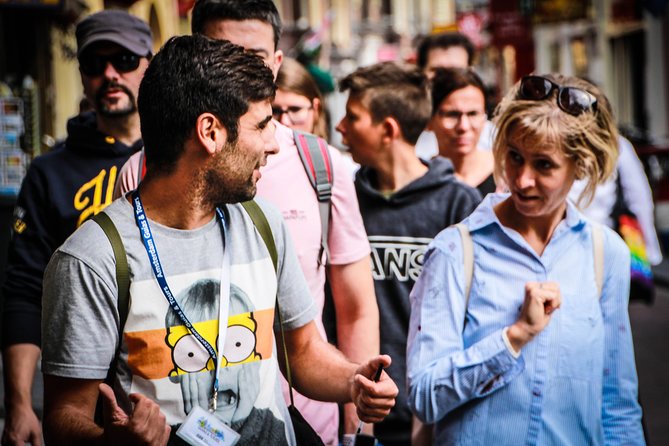
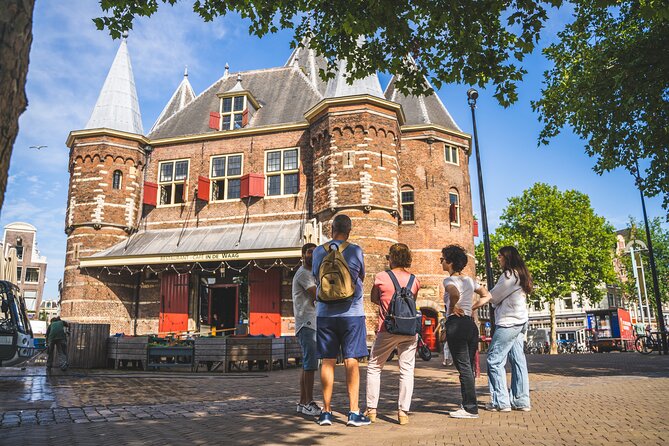
Next up is Nieuwmarkt, described as the new market, and nearby the San Antón Gate. This area sits close to the Chinese Quarter, but it’s distinct in character—more street-market energy, older urban seams, and a sense of “Amsterdam at human scale.”
The practical benefit is that this stop keeps you oriented through a dense part of town. You’re not just seeing one building; you’re walking through an urban fabric where gates and market areas shaped how people moved and traded.
If you like city history that shows up in everyday streets, this is one of those stops. It’s also a nice counterbalance before the tour moves toward the Jewish Quarter and the heavier World War II context.
Jodenbuurt: Jewish Quarter and World War II history
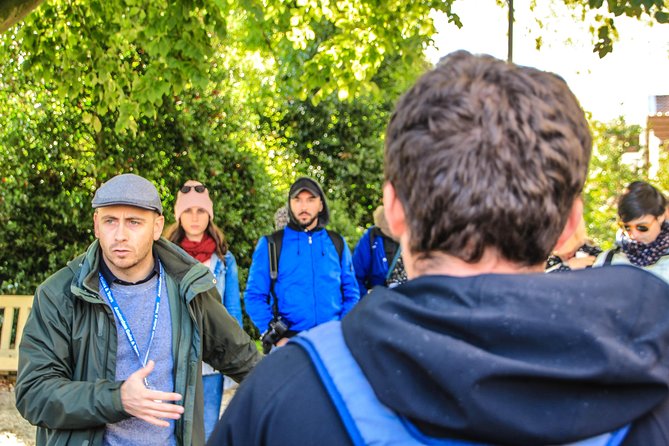
Then comes Jodenbuurt, a neighborhood you really can’t skip if you want the full Amsterdam picture. This part is where the tour turns more serious, with discussion of the Jewish Quarter and the sad history of World War II.
What makes this section meaningful is pacing and framing. A well-run walking tour here doesn’t just list tragedies—it gives you enough context to understand how the city changed and why these locations matter. One review notes that the tour can handle tough subjects sensitively, which is exactly what you want in this area.
Because this is a moving walk, pay attention to what your guide asks you to notice around you: the street layout, the feeling of the area, the significance of the places you pass. Even if you know some history already, seeing it tied to the specific streets helps it “stick.”
And if you’re traveling with teenagers or curious adults, this is a strong stop. It turns Amsterdam from pretty postcard canals into a place that has real human consequences behind the architecture.
Muntplein and the flower market: pretty with a point
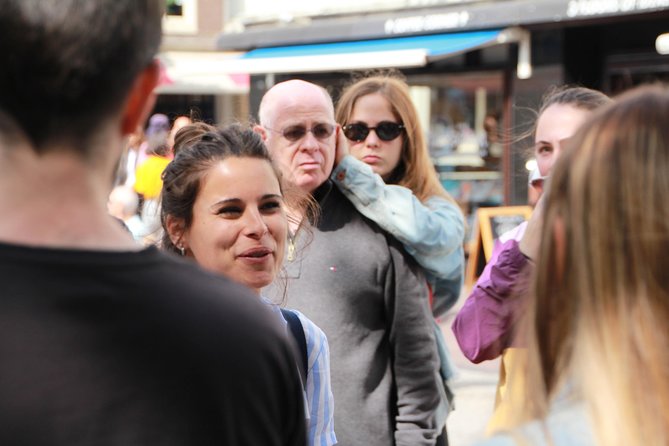
After the heavier part, the tour gives you relief—Muntplein, one of Amsterdam’s most famous squares. It’s especially popular thanks to the flower market nearby.
This is a great stop if you want to experience Amsterdam’s signature “life in the city center.” The flowers aren’t just decoration. They represent how Amsterdam’s public spaces work: people gather, buy, talk, and turn a square into a daily ritual.
It also helps you recover attention after Jodenbuurt. Walking tours can get emotionally heavy, and returning to a lively market square gives your brain a clean reset.
If you’re the type who loves photography, this stop is also where you’ll likely find easy angles. Big open space plus market energy tends to produce better shots than narrow side streets.
Begijnhof Gardens: quiet refuge in the middle of the city
Next is Begijnhof (near Spui Square in the tour’s flow), where you’ll visit the Begijnhof Gardens. This is one of those Amsterdam moments that feels like it belongs to a different speed.
The gardens offer a break from the loud street vibe. Even if you’re not a garden person, the value is how the city changes when you step into a calmer courtyard-like space. You get to understand why places like this became sanctuaries in dense urban life.
Your guide may also connect this stop to the Flower Market area and nearby sites like De Krijtberg Kerk. That kind of linking matters because it helps you build a mental map. When you later wander on your own, you’ll know what you’re seeing and why it’s there.
In short: Begijnhof is where the tour stops feeling like a lecture and starts feeling like a lived city.
Dam Square finale: Royal Palace, Nieuwekerk, National Monument
The walk ends at Dam Square, the heart of Amsterdam. Here you’ll see key landmarks including the Royal Palace, Nieuwekerk, and the National Monument.
This is an excellent finish because Dam Square is where Amsterdam’s civic identity shows. You’ve been moving through commercial beginnings, cultural layers, and wartime memory. Ending here gives you a sense of how the city organizes its official and public spaces.
If you want to turn this into an easy day plan afterward: Dam Square is a natural place to pick your next move. You’ll be in the center of everything—canal walks, museum options, and quick bites.
And if your guide is the type who offers personal suggestions at the end (some guides are known for that), ask directly before you part ways. It’s often the most useful part of the tour: tailored ideas based on what you like.
Optional 1-hour canal cruise: why it works after the walking
If you choose the canal cruise option, you’ll get a ticket for a 1-hour canal cruise. This add-on is popular for a reason: canals give you a different scale view of Amsterdam.
After walking, you start noticing patterns—bridge spacing, the way streets relate to water, and how the canal ring shapes the city. A cruise turns those patterns into something you can see at once.
Also, it’s a mental rest. Walking tours can feel like nonstop input. A canal ride lets your brain catch up while still giving you a guided payoff for choosing the extra option.
Practical tip: some people report confusion about canal tickets in certain situations. Before boarding, make sure you understand where you’re going and that your ticket details match what the operator expects. If anything feels unclear, ask immediately at the meeting point for the cruise.
Price and value: $24.08 for a guided, multi-neighborhood story
At about $24.08 per person, the value comes from what you’re buying: a professional guide, a structured walk, and a small group. You’re not paying for museum tickets, and many of the key stops are free to access.
Most importantly, you’re paying for interpretation. The route covers major landmarks and significant neighborhoods in a short time. That kind of guided threading saves you research time and helps you understand what you’re seeing while you’re standing in front of it.
The optional canal cruise also changes the math. If you’re interested in a canal ride anyway, the cruise ticket being included (when you select the option) can make the whole day feel better-rounded without stretching your budget.
If your goal is only a quick photo loop, this might feel like too much walking and context. But if you want city “why” as well as city “what,” it’s priced like a practical bargain.
Who should book this tour, and who might want a different fit
This tour fits best if you:
- want a first-time-or-near-first-day Amsterdam overview
- like walking routes that cover both iconic and less obvious areas
- appreciate context around serious history, handled with care
- prefer small groups and a guide who can keep people involved
You might consider a different option if you:
- need very quiet, highly structured pacing (some feedback mentioned disjointed moments or too much time in busy noisy spots)
- are very sensitive to hearing street-level audio without a headset
- expect a guided stop-by-stop schedule where the guide explains every single location for a set amount of time (some people felt the information timing could be uneven)
For most people, though, the mix of landmarks, neighborhoods, and the option to add a canal cruise is exactly how you make a limited time day feel complete.
Should you book the Amsterdam Highlights small-group walk?
If you’re asking whether this is worth your time, my answer is yes—especially if you like understanding Amsterdam as a real place, not just a skyline. The small group size, free-to-enter sights, and the way the route connects places like Centraal Station, the Jewish Quarter, and Begijnhof make it a strong “core day” activity.
Book it if you want a guide-driven route and a humane, story-focused pace, plus the option to end with a relaxed canal view. Just do one small thing that protects your experience: show up early at Beursplein and stay close to the guide in busy squares so you don’t miss the details.
FAQ
How long is the Amsterdam Highlights small-group walking tour?
The walking tour runs about 2 to 3 hours (included as a 2.5-hour tour).
What is the price per person?
The price is $24.08 per person.
What language is the tour offered in?
The tour is offered in English.
How big is the group?
This experience has a maximum of 10 travelers.
Where does the tour start and end?
It starts at Beursplein, 1012 JW Amsterdam, and ends at Dam Square Dam, 1012 Amsterdam.
Which major places are included in the route?
You’ll see Beursplein, Amsterdam Centraal, areas around the Chinese Quarter (including the Buddhist Temple of Amsterdam), Nieuwmarkt and San Antón Gate, Jodenbuurt, Muntplein, Begijnhof Gardens, and Dam Square (including the Royal Palace, Nieuwekerk, and the National Monument).
Is an optional canal cruise included?
A 1-hour canal cruise ticket is included if you select the canal cruise option.
Are tickets or admissions needed for the stops?
The provided stop details list admission ticket free for the featured sights along the walk.
What’s included in the cost?
Included are the 2.5-hour walking tour, a professional guide, small groups for a more personal experience, and a 1-hour canal cruise ticket if you choose the option.
Is food and drinks included?
No, food and drinks are not included.