REVIEW · AMSTERDAM
Amsterdam Red Light District Treasure: Self-Guided Tour & Quest
Book on Viator →Bookable on Viator
A phone quest in Amsterdam sounds gimmicky—until it puts you in the right streets. This self-guided treasure hunt links major landmarks like Centraal Station, Oude Kerk, and De Wallen with light, story-driven puzzles. I especially like that it runs on your schedule and works offline, so you’re not stuck hunting for data.
You’ll also get a simple “pause and resume” setup, which makes the whole thing feel calmer than a fixed walking tour. The main catch is that the challenges are intentionally easy, so if you live for hard escape-room logic, you may want something more demanding.
In This Review
- Key Highlights You’ll Care About
- The Big Idea: A Scavenger Hunt That Teaches You While You Walk
- Price and Value: What $11.45 Gets You (and Why It’s Not Just Cheap)
- Where It Starts and Finishes: Central Station to Ons’ Lieve Heer op Solder
- Stop 1: Centraal Station and the Neo-Renaissance “First Clue”
- Stop 2: The Old Center as Your Puzzle Transition
- Stop 3: Weeping Tower (Schreierstoren) and the Story of Departures
- Stop 4: Montelbaanstoren and the “Walls of Amsterdam” Angle
- Stop 5: De Wallen Red Light District, With a Respectful Context
- Stop 6: Nieuwmarkt Square, Commerce, and the Shadow of WWII
- Stop 7: Oude Kerk, Oldest Church, Newer Roles
- Stop 8: Ons’ Lieve Heer op Solder, the “Attic Church” Finale
- Timing and Pace: How the 1.5–2 Hours Really Works
- What Kind of Person Should Do This?
- Should You Book This Amsterdam Treasure Hunt?
- FAQ
- How long does the Amsterdam Red Light District treasure hunt take?
- What does it cost, and is it per person?
- Do I need an Internet connection?
- Where do I start and where does it end?
- Are there puzzle challenges, and how many?
- Can I pause and resume later?
- Are admission tickets included for all stops?
- What happens if I’m traveling with a group?
- Is there a refund if plans change?
Key Highlights You’ll Care About
- Offline phone play: no Internet required, so you can roam without signal stress.
- Start when you want at Central Station: you begin at your leisure, not at the mercy of a group deadline.
- 10 short challenges: they’re designed for quick problem-solving as you walk.
- A route that mixes viewpoints and surprises: defense towers, a medieval port story, a major church, and the Red Light District.
- Break any time, resume later: handy when crowds, weather, or your own curiosity slow you down.
- One group, private experience: only your group plays together (priced for up to 4).
The Big Idea: A Scavenger Hunt That Teaches You While You Walk
This experience turns Amsterdam into a series of mini missions. You’re not following a scripted route with constant narration. Instead, you use a mobile code to access the story, then solve clue-based steps to move from one spot to the next.
That approach matters in Amsterdam. The city rewards wandering, but it can also be overwhelming if you’re trying to “see everything” in a day. This game nudges you into a logical flow—Old Town to canals to De Wallen and back toward a very unusual final stop—without turning the day into a checklist.
Another thing I like: the emphasis on little stories tied to real places. At Weeping Tower (Schreierstoren), for example, the name connects to a human moment—women waiting and weeping when husbands left for war or fishing. At Oude Kerk, the church is treated as a cultural space now, where art and music mingle. You get meaning, not just coordinates.
The last design choice is practical: you can pause and resume. Amsterdam days have interruptions—cafés, lines, rain, and the sudden urge to sit on a canal edge. This format lets you keep your place rather than falling behind a guide.
You can also read our reviews of more guided tours in Amsterdam



Price and Value: What $11.45 Gets You (and Why It’s Not Just Cheap)
The price is $11.45 per group, up to 4 people. That’s the main value lever. Instead of paying per person for a “guided” experience, you’re paying for a group activity you can take at your own speed.
It’s also not a long commitment. Expect about 1 hour 30 minutes to 2 hours, depending on how long you linger at each stop. For that window, you’re covering a cluster of iconic sites and a few less-obvious structures (tower views, canal-side history, and a church-museum-house hybrid).
If you’re traveling with friends or family, this can be a smart use of time. You can do it even if you don’t want a guide’s lecture style. And because it’s self-guided, it’s easier to match to your group’s energy—slow walkers can take their time, faster walkers can keep momentum.
One caution on value: the itinerary includes stops where “admission ticket free” is listed and other stops where admission is marked as not included. So the experience is one thing, and optional add-on entry into certain buildings is another. Plan your budget if you want to go inside every site.
Where It Starts and Finishes: Central Station to Ons’ Lieve Heer op Solder

You begin at Amsterdam Central Station (1012 AB Amsterdam). It’s a perfect starting point because you can reach it by public transit, and it’s visually memorable even before you start the game.
Your final stop is Our Lord in the Attic Museum (Ons’ Lieve Heer op Solder), Oudezijds Voorburgwal 38-40, 1012 GD Amsterdam. That end point is a strong payoff: it’s one of those Amsterdam addresses that feels like a secret, even though it’s in the center.
The route is designed as a walkable arc. You’ll bounce between squares and canal-adjacent streets, then finish in a quieter inner-city lane setting. That’s good planning if you want a day that feels like exploring, not sprinting.
Stop 1: Centraal Station and the Neo-Renaissance “First Clue”
At Amsterdam Centraal Station, you’re not just meeting your game—it’s also your first lesson in how Amsterdam frames public space. The station is neo-Renaissance in style, designed by P.J.H. Cuypers, and completed in 1889.
Expect two layers here:
1) A real transport hub with shops and places to eat.
2) A historic building where the puzzle starts immediately.
The game gives you a challenge based on your surroundings, and that matters because it gets you thinking right away. You’ll get your bearings fast without needing a thick intro booklet. If you’re arriving by train or tram, you can start soon after you step out.
A small practical note: because there are shops and food nearby, it’s easy to oversnack before the quest even begins. If you want the walking parts to feel smooth, keep your first stop light.
Stop 2: The Old Center as Your Puzzle Transition

Next comes the Old Center, reached by following a clue and solving a puzzle. This stop is less about a single monument and more about the game teaching you how to “read” the city layout as you move.
That’s valuable if you’re new to Amsterdam. The city is famously navigable once you understand the rhythm: squares, small streets, canals, and landmarks that anchor your sense of direction. The puzzle format turns that skill on by walking you through it.
Since the listed entry is free here, you can spend time without worrying about ticket decisions. Use the moment to check your phone battery and confirm your headphones or sound settings if you prefer them that way.
You can also read our reviews of more tours and experiences in Amsterdam






Stop 3: Weeping Tower (Schreierstoren) and the Story of Departures
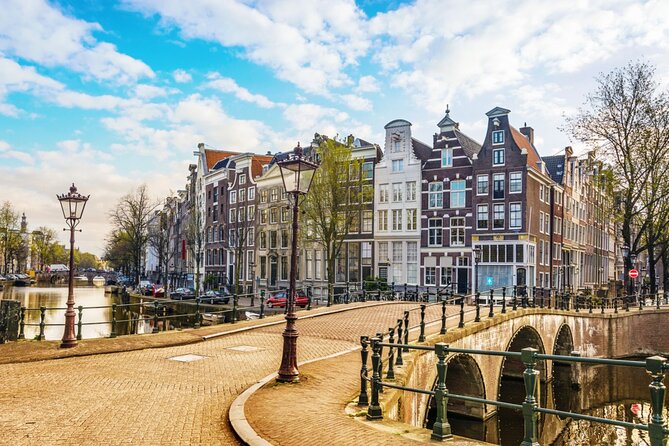
At The Schreierstoren, also called the Weeping Tower, you get a medieval defense structure with an unusually personal origin story. Originally built in the 15th century as a defense tower, the name connects to women who wept here as their husbands left from the port area for war or fishing.
That’s the kind of detail that makes Amsterdam feel human. It’s not a statue behind glass; it’s a place where emotions shaped the narrative.
The tower is also linked to Henry Hudson, who set sail from here on his journey to Northern regions. The game frames that connection as part of the clue flow, so you’re not just sightseeing—you’re assembling a story in your head as you go.
This stop is marked with admission ticket not included, so if you want to go inside (if it’s available during your visit), you’ll likely need to plan for separate entry. If you’re focused on the outdoor experience, you can still get a lot from the tower’s presence and the narrative.
Stop 4: Montelbaanstoren and the “Walls of Amsterdam” Angle
Then you move to Montelbaanstoren, a 48m-high tower on Amsterdam’s Oude Schans canal. The background is a period when Amsterdam was under siege, and the tower was built as part of the “Walls of Amsterdam” system defending the eastern harbor side.
This stop works well because it teaches you how canals aren’t just scenery. They were infrastructure. They were part of the city’s defensive logic, trade flow, and day-to-day movement.
The game asks you to answer one mystery question tied to the location in order to continue. It keeps the tone consistent: puzzle first, story second, then you walk on.
Again, admission is marked as not included for this stop. If you plan to enter, check site hours on the day. If not, consider it a “look up and find the structure” moment—Amsterdam towers are hard to miss once you know what you’re hunting for.
Stop 5: De Wallen Red Light District, With a Respectful Context
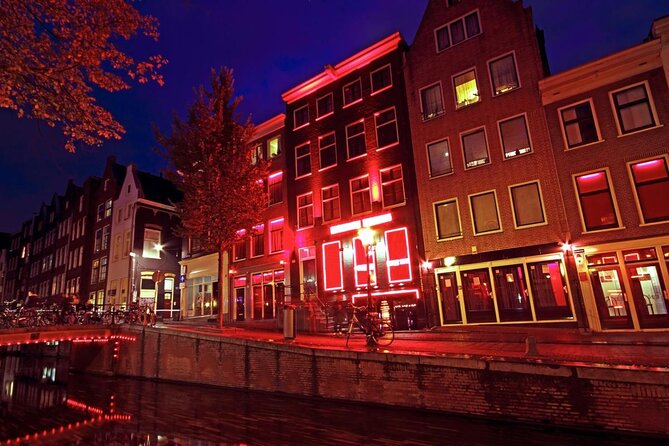
Now you reach De Wallen, the famous Red Light District area around the canals. The game positions it as iconic and highly visible: you’ll see sex shops, brothels, and the tight urban streets that make the district so unmistakable.
Amsterdam’s approach here is described as liberal and tolerant—choosing regulation and openness over criminalizing everything. That context is useful because it changes how you interpret what you see. Instead of treating it only as spectacle, you can think about how a city sets policy around sensitive topics.
The Red Light District part is listed with admission free, but do keep common-sense travel etiquette in mind. This area has a different social atmosphere, and it’s best experienced by staying aware, respectful, and not turning everything into a photo shoot.
This stop is where the quest rhythm slows a bit, with time set aside. It’s also a place where you might naturally pause for people-watching and street detail before moving on.
Stop 6: Nieuwmarkt Square, Commerce, and the Shadow of WWII
Next is Nieuwmarkt, a central square tied to centuries of social and commercial life. The square is described as a hub since the 17th century, lined with cafés and restaurants that make it feel more like an urban neighborhood than a staged tourist node.
Nieuwmarkt also has a darker layer: during WWII, it was used by Nazis as a collection point for Jews being sent to concentration camps. The game doesn’t just say that and move on—it uses clue challenges around nearby places to bring your attention to what stands in plain sight.
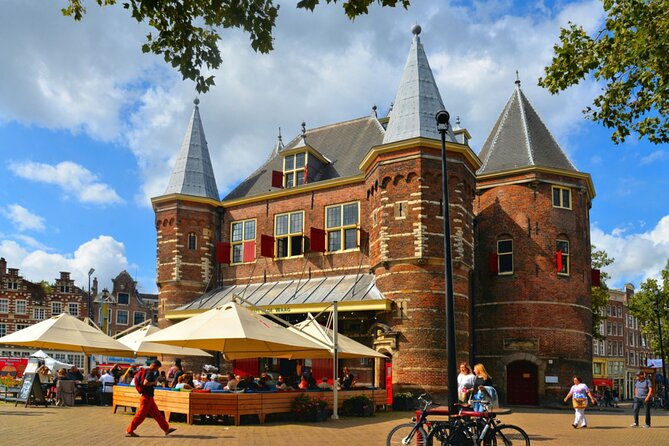
Nieuwmarkt is dominated by De Waag, historically an entry point to the city before old city walls were destroyed. The game points you to look around and solve a challenge to unlock the full story connected to the space.
If you’re the type who prefers lighter sightseeing, this stop may feel heavy. But it’s also one of the most meaningful ways to understand Amsterdam: the city has layered identities, and the ground itself holds them.
Stop 7: Oude Kerk, Oldest Church, Newer Roles
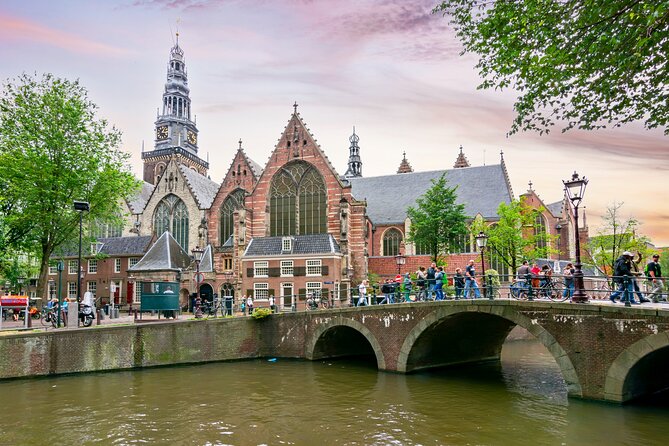
At Oude Kerk (Old Church), you’ll get a jolt of architecture in the middle of the inner-city streets. The Oude Kerk is described as Amsterdam’s oldest building and for centuries its most important church.
What makes this stop more interesting than a typical “look at the church” moment is the modern usage. In 2016 it became an official museum space that hosts contemporary artists to exhibit and interact with the historic interior. In other words: the building isn’t just preserved; it’s used.
The game invites you to look for clues, but the practical takeaway for you is this: if you only pass churches from the outside, you’ll miss how Amsterdam keeps adapting old structures into living venues.
Admission here is marked not included, so if you want to see the museum elements, plan on a separate ticket. If you’re only doing the exterior, still expect the scale to impress you. The structure is monumental even from a distance.
Stop 8: Ons’ Lieve Heer op Solder, the “Attic Church” Finale
Your finish is Our Lord in the Attic Museum (Ons’ Lieve Heer op Solder), described as a 17th-century canal house with a top floor converted into a Catholic church. The experience is framed as a 3-in-1 combination: canal house, church, and museum.
This ending point is where the whole game’s personality clicks. Amsterdam’s story here is about tolerance and freedom of religion, and the museum is positioned as a reflection of that openness. Instead of ending with another big street landmark, the route closes on a small, unusual interior concept that feels like a hidden narrative.
Admission is marked not included at the final stop. If you want to see the museum, you’ll likely need to purchase entry separately (if it’s required during your timeframe).
If you’re worried you’ll be too tired at the end: don’t be. This is the kind of payoff where you can slow down, take photos responsibly, and let the story settle.
Timing and Pace: How the 1.5–2 Hours Really Works
The format is designed for walking at a human pace. With about 10 puzzle challenges, the game naturally breaks your time into smaller chunks. Each segment is short, so you don’t feel stuck traveling one long distance with nothing to do.
Also, you can take breaks and resume later. That matters because Amsterdam weather can change fast and crowds can shift quickly. Rather than finishing the route no matter what, you can stop when you want and continue when you’re ready.
If you start during daytime, you’ll likely find the city easy to read and the landmarks easier to spot. If you start later in the evening, you might enjoy different atmosphere around canals and squares, but be mindful of footing on narrow streets.
What Kind of Person Should Do This?
This is a great fit if you want:
- A self-paced way to get your bearings in central Amsterdam
- Story-forward walking with light puzzles
- A route that covers major areas, including the Red Light District, without forcing you into a rigid tour group pace
It’s also a good choice for people who like planning their own day but still want structure. You’re not just wandering; you’re following clue steps that keep you moving toward worthwhile places.
If you want intense, brain-twisting escape-room difficulty, you may find the puzzles too simple. The best expectation is “fun city detective work,” not “solve complex riddles under pressure.”
Should You Book This Amsterdam Treasure Hunt?
I’d book it if your goal is to see central Amsterdam in a smart, low-stress way. The price for a group up to 4 is hard to beat, and the offline setup makes it easy to keep walking even when your phone signal is weak.
Skip it—or pair it with something else—if you know you want high-challenge puzzles or a fully guided museum-and-talking itinerary. This is about pace and place, not tough game mechanics.
If you like the idea of walking from Centraal Station toward Oude Kerk and ending at Ons’ Lieve Heer op Solder, this format is a practical way to turn those stops into a single story arc.
FAQ
How long does the Amsterdam Red Light District treasure hunt take?
It takes about 1 hour 30 minutes to 2 hours.
What does it cost, and is it per person?
The price is $11.45 per group, up to 4 people.
Do I need an Internet connection?
No. The experience is designed to run offline, so you don’t need WiFi.
Where do I start and where does it end?
It starts at Amsterdam Central Station and ends at Our Lord in the Attic Museum (Ons’ Lieve Heer op Solder) at Oudezijds Voorburgwal 38-40.
Are there puzzle challenges, and how many?
Yes. The experience includes 10 puzzle challenges.
Can I pause and resume later?
Yes. You can break at any time and then resume your quest later.
Are admission tickets included for all stops?
Not all stops. Some stops are listed as admission ticket free, while others are listed as admission ticket not included.
What happens if I’m traveling with a group?
It’s a private activity, and only your group participates.
Is there a refund if plans change?
You can cancel for a full refund if you cancel at least 24 hours before the start time.