REVIEW · AMSTERDAM
Amsterdam Highlights and History Walking Tour (MUST DO)
Book on Viator →Operated by Trigger Tours · Bookable on Viator
First time in Amsterdam? This walk helps everything click. I love the small-group feel (max 15) because it’s easier to hear details and ask questions, and I love how the route links politics, religion, and everyday city life in a way that feels practical for a short stay. Expect classic stops like Dam Square and the UNESCO canal ring, plus older, calmer corners such as a Beguine courtyard and the Old Church.
One thing to consider: this is still a two-hour, on-your-feet walk, and you’ll need to watch for bike traffic while moving through the center.
In This Review
- Key highlights to know before you go
- Getting your bearings fast: the best logic for a first Amsterdam walk
- Price and value: what $26.91 buys you in 2 hours
- Route and pace: comfortable walking, but plan for your feet
- Dam Square: Amsterdam’s political center and cultural stage
- UNESCO canal ring: engineering you can actually see
- A 14th-century Beguine courtyard: a different kind of Amsterdam
- Old Church and Royal Palace: power and religion across centuries
- Old Church (13th century)
- Royal Palace context (17th century)
- Nieuwmarkt: markets and everyday life on a former walled site
- Guides: why small groups change the whole experience
- Who should book this tour (and who might skip it)
- Should you book this Amsterdam Highlights and History tour
- FAQ
- How long is the Amsterdam highlights and history walking tour?
- What does the tour cost?
- Is the tour offered in English?
- Where do I meet, and where does the tour end?
- What’s included in the ticket price?
- Are food and drinks included?
- Can I cancel for free, and what if the tour doesn’t run?
Key highlights to know before you go
- Dam Square orientation in the middle of Amsterdam’s political and cultural story
- UNESCO canal ring views tied to real urban planning and engineering ideas
- A 14th-century Beguine courtyard that shows how religious life shaped the city
- Old Church time travel from a 13th-century Catholic church to a Protestant and cultural center
- Royal Palace context: how a 17th-century town hall became a royal landmark
- Nieuwmarkt today where a former walled-city site lives on as a daily market square
Getting your bearings fast: the best logic for a first Amsterdam walk
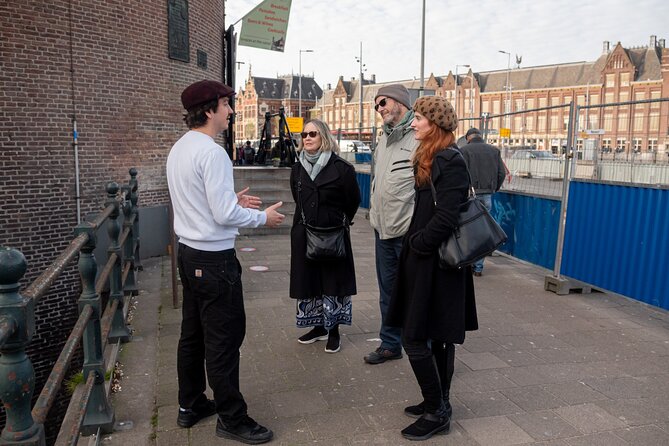
This tour is built for people who want a working map of the city without spending days guessing. In two hours, you cover several “anchor points” that show up in photos for a reason. But the real value is that each stop is explained as part of a bigger timeline, so Amsterdam stops looking like random pretty streets and starts looking like one connected place.
You’ll also benefit from the way the group size stays small. Guides have been praised by name in the past, including Andrea, Aaron, Gio, David, and James, and the common thread is how they keep the pace friendly while still sharing lots of specifics. That matters, because a walking tour can either feel like a lecture headset—or like a conversation with a local who points out what you’d miss on your own.
Finally, the route makes sense if you’re planning the rest of your day afterward. You finish back near where you start, so you’re not stranded miles away from your hotel.
You can also read our reviews of more walking tours in Amsterdam


Price and value: what $26.91 buys you in 2 hours
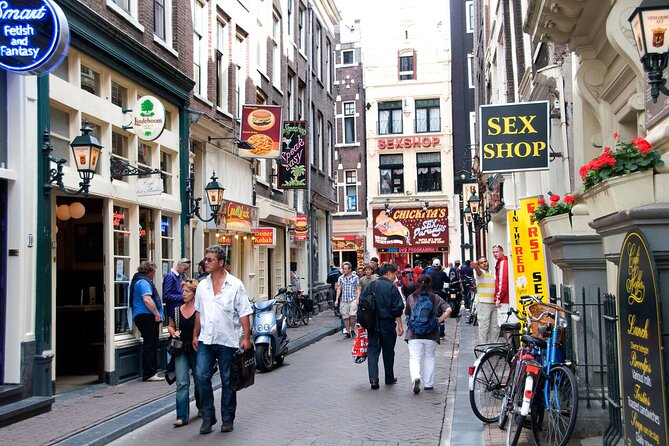
At $26.91 per person for about two hours, this isn’t a bargain “just because it’s cheap” kind of deal. It’s priced like a focused city orientation with a local guide, and the stop list is dense: major landmarks plus lesser-seen historical spaces.
Here’s why it feels like good value:
- Time efficiency: you get context for several iconic areas in one go.
- Small-group attention: max 15 travelers means fewer people competing for the guide’s attention.
- Practical history: the stories tie into what you can still see today—squares, church buildings, civic architecture, and market life.
If you’re visiting for the first time and your schedule is tight, paying for this upfront can save you from doing the “museum-only” approach and missing the street-level reasons the city looks the way it does.
Route and pace: comfortable walking, but plan for your feet
This tour runs about 2 hours. That’s long enough that your legs will feel it, even if the pace is described as moderate. It’s also a real street walk in a cycling-heavy city center, so you’ll want shoes with grip and the habit of watching where you step.
A few practical tips:
- Wear comfortable walking shoes with good traction.
- Bring a light layer; weather can shift fast in open squares and canal-side stretches.
- Be ready to stop and start as the guide points out details around you.
Also note: it’s offered in English, and most people can participate, including the ability to travel with service animals (allowed).
Dam Square: Amsterdam’s political center and cultural stage
You start at Damrak (Damrak 1-5), and the first major mental anchor is Dam Square. This place matters because it has been a site of political and cultural significance for centuries, which means the square isn’t just a scenic landmark—it’s a location where power, public life, and identity have been negotiated over time.
On a good walking tour, Dam Square works as a first “translation layer.” You begin to see why ceremonies, civic buildings, and big public moments cluster where they do. Even if you’ve only seen photos, you’ll understand what shaped the square’s importance and how it ties into the wider city.
A drawback to know: squares can be crowded and windy. If you’re sensitive to noise or weather, you might feel it more here than on quieter side streets later in the walk.
UNESCO canal ring: engineering you can actually see
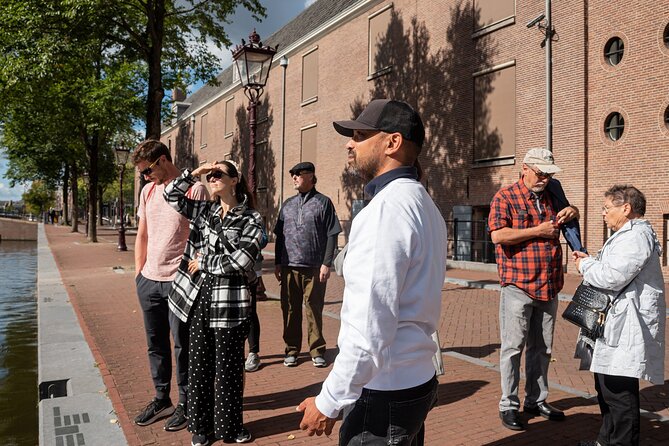
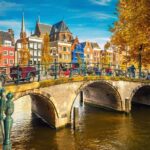
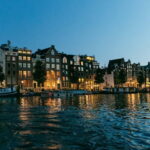
Next comes the heart of the postcard image—Amsterdam’s canal ring, a UNESCO World Heritage Site. What I like about this stop is that it’s not treated like a static view. The explanation focuses on the canal ring as a result of innovation in urban planning and engineering, plus the cultural heritage woven into the water-lined streets.
This is where the tour helps you look smarter. Instead of only noticing the pretty façades, you start paying attention to why canals exist in the way they do: how the city developed, where space was allocated, and how waterways became part of civic and economic life.
One more reason it’s a high-value stop: canal-side walking is easy to enjoy. Even if you’re not a history super-fan, it’s one of those locations where the city does half the entertaining for you.
You can also read our reviews of more historical tours in Amsterdam





A 14th-century Beguine courtyard: a different kind of Amsterdam
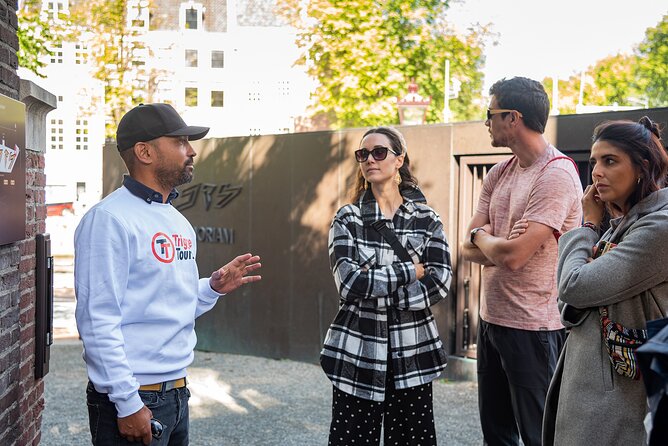
Then you slow down into something more intimate: a historic courtyard dating back to the 14th century. This is one of the oldest and best-preserved parts of Amsterdam, and it connects to the Beguines—religious women who lived in a semi-monastic community.
What makes this stop special is tone. A lot of Amsterdam history you hear is about governments, trade, or church power. Here, the story shifts toward daily religious life and how communities formed within the city fabric. It’s the kind of detail that makes you realize Amsterdam wasn’t only built by rulers and merchants. It was also built by communities trying to live meaningful lives in the middle of a growing city.
If you’re the kind of traveler who likes your history with a human scale, this courtyard is a highlight.
Old Church and Royal Palace: power and religion across centuries
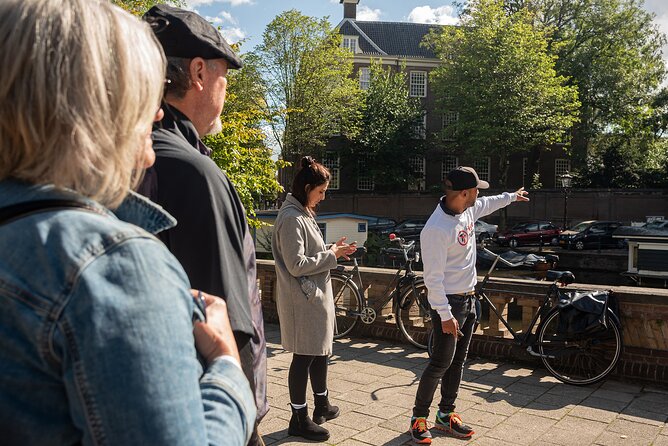
The tour moves from one major old building to another.
Old Church (13th century)
You’ll see the Old Church, Amsterdam’s oldest surviving building dating back to the 13th century. It began as a Catholic church, later used by Protestant congregations, and today it functions as a cultural center.
That mix of past and present is the point. The guide’s job here is to show how religious space doesn’t always vanish—it changes role. You get a clearer picture of how Amsterdam’s religious and civic identity shifted without erasing the architecture.
Royal Palace context (17th century)
Then it’s the Royal Palace, originally built as a town hall in the 17th century. It’s now one of three palaces used by the Dutch royal family, and it’s an example of Dutch classicism. It’s also open to the public for tours.
Even if the walking tour doesn’t turn into a long interior visit, this is still a valuable moment. It helps you connect the idea of a city hall to what power looks like later. You can stand outside and understand how civic administration morphed into royal symbolism, with the building still doing the same job: telling the public who matters.
Nieuwmarkt: markets and everyday life on a former walled site
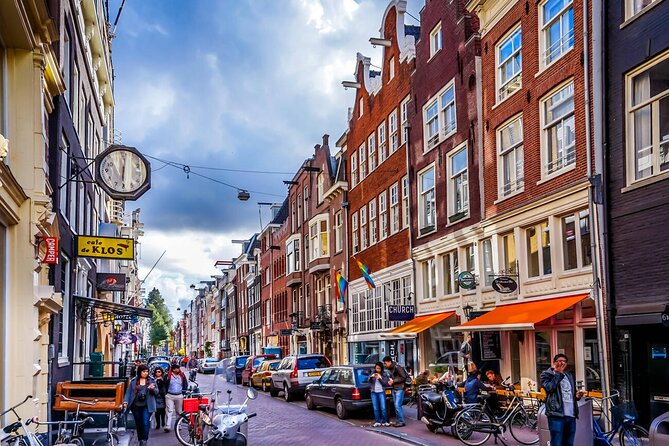
The walk ends with a very Amsterdam kind of finale at Nieuwmarkt. This square used to sit where the city walls were in the 17th century. Now it’s a busy place with a daily market, cafes, and restaurants.
This is a smart stop to finish on, because it grounds the whole tour. After you’ve spent time on squares, churches, palaces, and canals, you get a reminder that Amsterdam’s history doesn’t just live behind doors. It lives in how people gather, shop, eat, and meet up.
Also, this is the kind of place where you can easily continue your own day afterward. Whether you want a snack, a sit-down meal, or just a place to people-watch, Nieuwmarkt gives you options right away.
Guides: why small groups change the whole experience
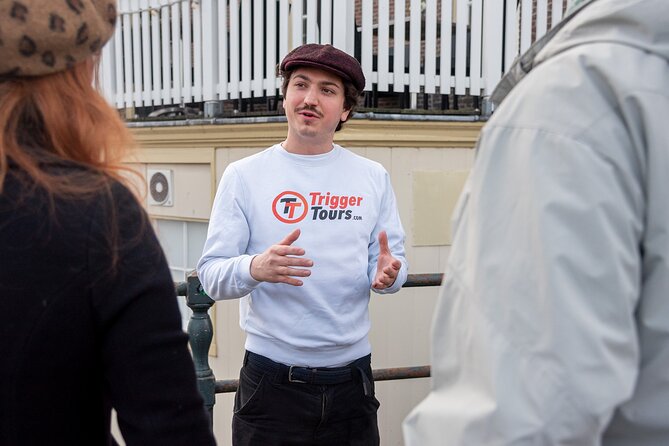
The guide is the difference between a walk that gives you facts and a walk that makes you notice the city. Past guides named in feedback include Andrea, Aaron, Gio, David, and James, and they’re repeatedly praised for being engaging and for making history feel readable, not stuck in a textbook.
The best part is how Q&A often works better in a small group. With fewer people, you don’t just hear dates—you get explanations that connect to what you’re looking at right now. If you’re the type who always wonders why a building is shaped a certain way or why a city plan turned out like it did, this format fits you.
Who should book this tour (and who might skip it)
I’d book this if:
- You’re on a short stay and want an orientation that goes beyond landmarks.
- You like history that connects to places you can still see today.
- You’re okay walking for about two hours and staying alert to bicycle traffic.
I’d think twice if:
- You struggle with standing and walking for that length of time.
- Crowded streets and bike lanes stress you out.
- You want a mostly indoor or museum-heavy experience.
Should you book this Amsterdam Highlights and History tour
Yes—if your main goal is to get oriented and understand what you’re seeing without building a detailed plan from scratch. The price feels fair for a guided, stop-rich two hours, and the max 15 travelers helps keep the experience personal.
Before you go, check your own comfort level with an active walking pace and bike traffic. If that’s manageable, you’ll leave with a mental map that helps you explore the rest of Amsterdam with way less confusion—and way more confidence.
FAQ
How long is the Amsterdam highlights and history walking tour?
It runs for about 2 hours.
What does the tour cost?
The price is $26.91 per person.
Is the tour offered in English?
Yes, it’s offered in English.
Where do I meet, and where does the tour end?
You start at Damrak 1-5, 1012 TM Amsterdam, Netherlands, and the tour ends back at the meeting point.
What’s included in the ticket price?
You get a local guide and a tour of Amsterdam.
Are food and drinks included?
No. Food and drinks are not included.
Can I cancel for free, and what if the tour doesn’t run?
Free cancellation is available up to 24 hours in advance for a full refund. If the tour is canceled because a minimum number of travelers isn’t met, you’ll be offered a different date/experience or a full refund.